
HVAC & Electrical Trade School Insurance
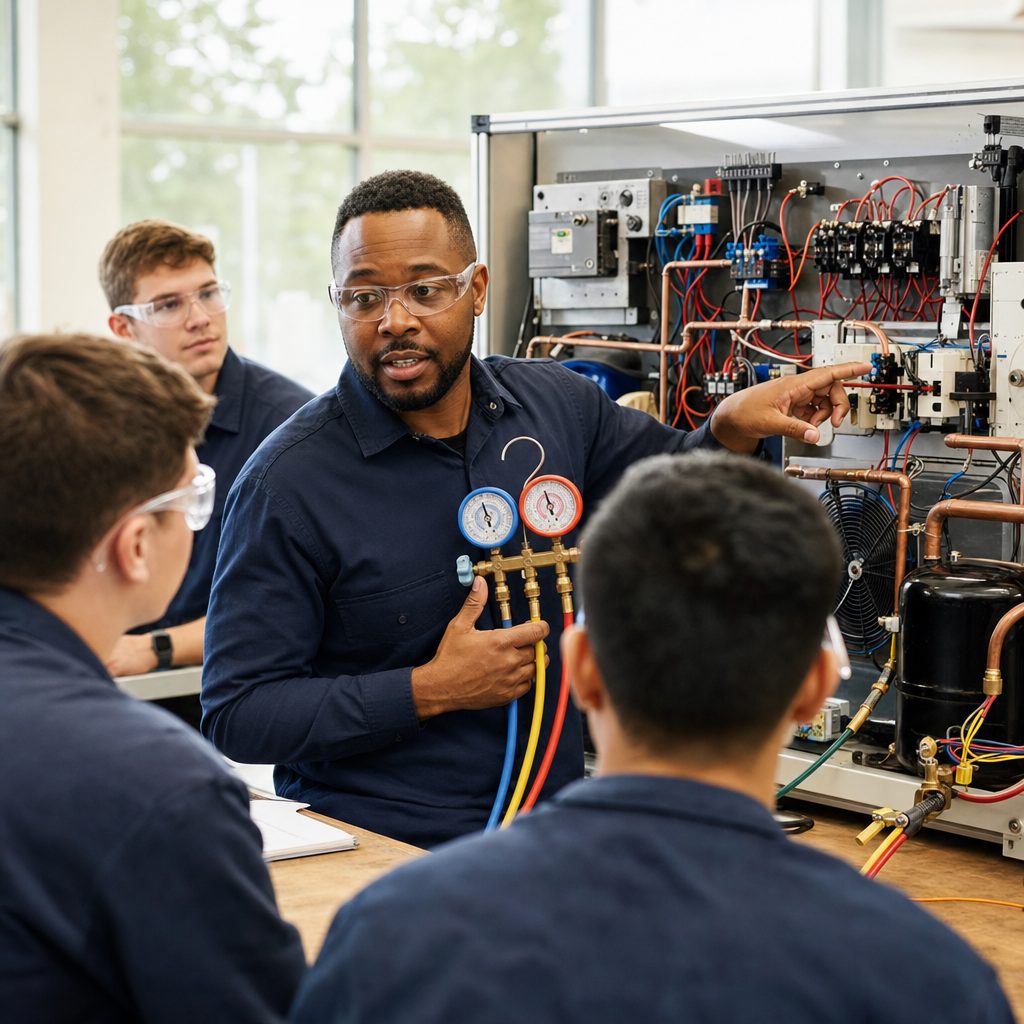
HVAC and electrical trade schools put live voltage, energized panels, and pressurized refrigerant in the hands of students who are still learning. When a shop-floor lab carries 480-volt panels and arc-flash energy, your insurance has to answer for the injury in the lab today and the graduate's mistake on a jobsite years from now.
Carriers We Represent
Why HVAC & Electrical Trade Schools Need Specialized Insurance
An HVAC and electrical trade school is one of the few classroom environments where the curriculum itself is a hazard. Students wire live circuits, energize 240- and 480-volt training panels, braze refrigerant lines, and work next to equipment that can produce an arc flash reaching 35,000 degrees Fahrenheit. The defining exposure is participant injury inside the training lab: electrocution, shock, arc-flash burns, and brazing or pressurized-refrigerant accidents that happen to enrolled students while they are performing the very work they came to learn. A standard general liability or BOP policy is written for the public slipping in your lobby, not for a student taking 480 volts across an energized panel, and the participating-student injury is frequently disputed or excluded unless the program is underwritten as a hands-on trade lab.
The second exposure is downstream and far larger. A trade school's product is a certified graduate, and a graduate who was negligently trained can cause catastrophic harm in the field, a fire, a CO poisoning, an electrocution, a code violation that injures a homeowner. Plaintiffs increasingly name the training institution in those suits, and life-safety-trade liability has produced multimillion-dollar verdicts where instruction was found inadequate. Carrier-specific commercial insurance programs blend named-participant student accident coverage, professional liability, and the GL/property stack so both the lab injury and the field-failure claim are answered.
Because EPA Section 608 certification, NFPA 70E electrical safety practices, and OSHA shop standards govern what happens on your training floor, the policy also has to align with how regulators expect a teaching lab to be run. The U.S. Environmental Protection Agency's Section 608 program makes refrigerant handling a regulated activity even in an instructional setting (see the EPA's Section 608 Technician Certification Requirements).
- Student electrocution, electric shock, and arc-flash burns sustained while working energized training panels in the lab
- Brazing, soldering, and torch burns plus pressurized-refrigerant and cylinder-rupture injuries during hands-on HVAC instruction
- Failure-to-train / negligent-instruction claims when a graduate causes a field fire, CO poisoning, or electrocution
- Life-safety-trade professional liability exposure with documented multimillion-dollar verdicts against training providers
- Failure-to-certify and failure-to-place E&O when promised EPA 608, licensure, or job-placement outcomes do not materialize
- Lab and shop equipment loss: training panels, HVAC trainers, recovery machines, gauges, meters, and tools
- Refrigerant release, fume, and ventilation incidents that trigger environmental and EPA-compliance questions
Core Coverages for HVAC & Electrical Trade Schools
The lead coverage is named-participant / student accident liability that responds to electrocution, shock, arc-flash, burn, and refrigerant injuries to enrolled students performing energized or pressurized lab work, the precise activity a base GL form is built to exclude. Layered above that is educators professional liability and errors-and-omissions for negligent instruction, failure to certify, and failure-to-place exposures, plus a downstream component addressing the school's liability when an improperly trained graduate causes life-safety harm in the field. This is the spine of an HVAC and electrical trade school program and should be quoted first, not bolted on.
General liability covers the non-participant public, slip-and-fall in the lobby, a visiting parent, a vendor, while commercial property and inland-marine coverage protects the building plus the high-value teaching assets: 480-volt training panels, HVAC simulators, refrigerant recovery machines, gauges, multimeters, and hand tools. Workers' compensation covers your instructors and staff, who themselves work around energized equipment and torches. Because refrigerant handling and arc-flash work create regulated and environmental exposures, pollution/environmental and equipment breakdown can be added where the lab warrants it.
Rounding out the stack: a surety bond satisfies state proprietary-school licensing, EPLI protects against employment claims from a staff of instructors, cyber/student-data coverage addresses FERPA-protected enrollment records, and a commercial umbrella sits over the GL, auto, and participant layers given the severity of an arc-flash or field-failure loss. We assemble this through commercial insurance built around how a hands-on trade lab actually operates.
- Named-participant / student accident liability for shock, electrocution, arc-flash, burn, and refrigerant injuries in the lab
- Educators professional liability / E&O for negligent instruction, failure-to-certify, and failure-to-place claims
- Downstream life-safety liability addressing harm caused by improperly trained graduates in the field
- General liability for non-participant public, premises, and slip/fall exposures
- Commercial property and inland marine for training panels, HVAC trainers, recovery machines, meters, and tools
- Workers' compensation for instructors and staff working around energized equipment and torches
- Surety bond for proprietary-school licensing, plus EPLI, cyber/FERPA, equipment breakdown, and a commercial umbrella
Licensing, Compliance & Regulatory Considerations for HVAC & Electrical Trade Schools
HVAC and electrical trade schools are typically licensed as proprietary or postsecondary career schools by a state proprietary-school board, council, or department of education. That licensure almost always carries a surety bond requirement that protects students if the school closes mid-program or cannot deliver promised training; bond amounts vary by state, commonly ranging from roughly $5,000 to $25,000 or more. Many state proprietary-school boards also require proof of liability insurance and detailed disclosure of program outcomes and refund policies as a condition of approval.
On the training floor, three federal/consensus regimes govern what you teach and how. EPA Section 608 makes refrigerant handling a certified, regulated activity, so your program must teach and test to it and you must manage refrigerant responsibly even in instruction. NFPA 70E, the Standard for Electrical Safety in the Workplace, governs arc-flash and shock protection and is the recognized practice OSHA references for energized work; your lab should mirror its boundary, PPE, and energized-work-permit practices. OSHA shop and PPE standards apply to your instructors and to the lab environment students train in.
Underwriters expect alignment with these regimes, and the surety bond requirement specifically flows from state career-school law (see, for example, a state's proprietary and postsecondary school bond requirement), while NFPA 70E sets the arc-flash safety bar your lab is measured against (see NFPA 70E, Standard for Electrical Safety in the Workplace).
- State proprietary-school board / postsecondary career-school licensing and program approval
- Surety bond posted as a condition of licensure to protect student tuition if the school cannot complete training
- EPA Section 608 refrigerant-handling certification taught and tested within the HVAC curriculum
- NFPA 70E arc-flash, shock-protection, PPE, and energized-work-permit practices mirrored in the lab
- OSHA shop, electrical, and PPE standards governing the training environment and instructors
- Proof-of-insurance and outcome/refund disclosure requirements tied to school licensure
- Recordkeeping for student certifications, completion, and placement that supports E&O defense
Why HVAC & Electrical Trade Schools Choose The Allen Thomas Group
The Allen Thomas Group is a family-owned, independent insurance agency founded in 2003, licensed in 28 states and backed by 15-plus A-rated carriers, with an A+ rating from the Better Business Bureau. We are not a single-carrier captive; we represent your trade school to the market and place its coverage with the carriers that genuinely understand hands-on, energized training environments rather than treating your lab like an ordinary classroom.
That independence matters most for a school whose risk lives at the intersection of participant injury and professional liability. We know which carriers will write named-participant student accident coverage alongside educators E&O and a downstream-failure component, and which will quietly exclude exactly the energized-lab injury you most need covered. We read the forms, close the gaps, and structure the program so the lab incident and the field-failure claim both have a clear answer.
Our clients get a long-term advocate, not a transaction. We conduct annual coverage reviews as enrollment, equipment, and program offerings change, advocate at claim time, and tap education- and specialty-trade carrier relationships that most local agents cannot reach.
- Family-owned, independent agency established in 2003, never a single-carrier captive
- Licensed in 28 states with access to 15+ A-rated carriers and an A+ BBB rating
- Experience placing named-participant student accident coverage alongside educators E&O
- Carrier knowledge of energized-lab, arc-flash, and refrigerant training exposures
- Hands-on form review to close participant-injury and failure-to-train coverage gaps
- Annual reviews as enrollment, equipment, and program offerings evolve
- Education and specialty-trade carrier relationships plus direct claim advocacy
How Much Does HVAC & Electrical Trade School Insurance Cost?
Premiums are driven by the things that change your risk: total enrollment and the number of students in energized or hands-on labs at one time, the count and credentials of instructors, annual payroll, how much live-voltage and refrigerant work the curriculum includes, the replacement value of training panels and lab equipment, your building and contents values, and your claims and any prior injury history. A school that runs large energized-panel labs prices differently than one teaching mostly theory and simulation.
As rough planning figures, a small to mid-size HVAC and electrical trade school often sees general liability in the range of roughly $1,500 to $5,000 per year, with named-participant student accident and educators professional liability frequently adding several thousand dollars more depending on lab intensity and graduate volume. Workers' compensation is rated on instructor payroll and trade classification, commercial property tracks the value of your panels and equipment, and a surety bond is typically a modest annual cost set by your state's required bond amount.
The most reliable way to budget is a tailored quote. Because we compare 15-plus A-rated carriers, we can show you where the participant-injury and E&O spine is properly covered, not just where the headline GL number looks cheapest.
- Enrollment and the number of students in energized or hands-on labs simultaneously
- Number and credentials of instructors plus total annual payroll
- Intensity of live-voltage, arc-flash, brazing, and refrigerant work in the curriculum
- Replacement value of training panels, HVAC trainers, recovery machines, and tools
- Building and contents values and overall property schedule
- Claims history, prior student-injury losses, and any field-failure litigation
- State-mandated surety bond amount and elected umbrella limits
HVAC & Electrical Trade School Risk Management & Coverage Considerations
The single most important loss-control practice is treating the lab like a regulated worksite, not a classroom. Build your energized-work training around NFPA 70E: defined arc-flash boundaries, required PPE, energized-work permits, lockout/tagout drills, and a strict supervision ratio so no student works a live panel without a credentialed instructor present. Document credentialing for every instructor and keep the lab to the same safety standard a contractor would be held to in the field.
Equally important is disciplined participation paperwork and recordkeeping. Signed participation and assumption-of-risk agreements, documented safety orientation, and proof that EPA 608 and electrical-safety content was actually delivered all strengthen both your participant-injury defense and your failure-to-certify E&O position. Track completions, certifications, and placement claims carefully, because the records you keep are what defend the downstream graduate-failure suit. Protect FERPA-covered student data with sound cyber practices, and maintain a written emergency and incident-response plan for shock, burn, and refrigerant-release events.
Emerging risks to watch include the shift to high-voltage heat pumps, EV and battery systems, and flammable A2L and other low-GWP refrigerants entering HVAC curricula, each of which raises the energy, fire, and certification stakes inside the lab. Review coverage whenever you add these programs.
- Run energized-work training to NFPA 70E: arc-flash boundaries, PPE, energized-work permits, and lockout/tagout
- Enforce instructor-to-student supervision ratios so no student works a live panel unsupervised
- Require signed participation and assumption-of-risk agreements and document safety orientation
- Maintain instructor credentialing records and verify EPA 608 content is delivered and tested
- Track completions, certifications, and placement claims to defend failure-to-train and E&O suits
- Protect FERPA-covered student data and keep a written shock/burn/refrigerant-release emergency plan
- Reassess coverage as A2L refrigerants, heat pumps, and EV/battery systems enter the curriculum
Frequently Asked Questions
Does general liability cover a student who is electrocuted or burned in our training lab?
Often not on its own. Standard general liability is written for the non-participating public and frequently disputes or excludes injury to an enrolled student performing the hazardous activity itself, such as taking a shock from a live panel or an arc-flash burn. The fix is named-participant or student accident liability underwritten specifically for a hands-on energized lab, which is why we lead an HVAC and electrical trade school program with it.
What is failure-to-train or life-safety liability, and why does it matter for a trade school?
It is the school's exposure when a graduate who was negligently trained later causes serious harm in the field, a fire, carbon-monoxide poisoning, an electrocution, or a code violation that injures someone. Plaintiffs increasingly name the training institution in those suits, and because the trades involve life safety, verdicts can reach the millions. Educators professional liability with a downstream-failure component is designed to respond.
What is failure-to-certify E&O coverage?
If your school promises an outcome, an EPA 608 pass, a licensure result, or job placement, and that outcome does not materialize, a student may bring an errors-and-omissions claim. Failure-to-certify and failure-to-place E&O responds to those professional-liability allegations, separate from any bodily-injury claim.
Is general liability the same as professional liability for our school?
No. General liability covers bodily injury and property damage to third parties on your premises, like a visitor slipping in the lobby. Professional liability / educators E&O covers claims arising from how you instruct and certify, negligent training, failure to certify, failure to place. An HVAC and electrical trade school needs both, plus participant coverage for student lab injuries.
Do we need workers' compensation for our instructors?
Yes. Most states require workers' compensation once you have employees, and your instructors work around energized panels, torches, and refrigerant, so the exposure is real. Coverage pays medical costs and lost wages for staff injured on the job and is rated on instructor payroll and trade classification.
Are EPA 608 refrigerant handling and NFPA 70E relevant to insurance?
Very. EPA Section 608 makes refrigerant handling a federally regulated, certified activity even in instruction, and NFPA 70E is the recognized arc-flash and electrical-safety standard OSHA references for energized work. Underwriters expect your lab to align with both, and demonstrating that compliance both reduces loss frequency and supports your defense if a claim occurs.
Does our school need a surety bond?
Almost always. State proprietary-school or postsecondary career-school licensing typically requires a surety bond as a condition of approval, protecting student tuition if the school cannot complete promised training. Required amounts vary by state, commonly from roughly $5,000 to $25,000 or more. We arrange the bond alongside your liability program.
What coverage do we need as we add heat pumps, EV systems, and A2L refrigerants?
Those programs raise the energy, fire, and certification stakes inside the lab: high-voltage systems, battery hazards, and mildly flammable A2L refrigerants. They can affect participant-injury, property, and pollution exposures, so you should notify your agent and review coverage whenever you add them. We adjust your program at the annual review or sooner as the curriculum evolves.
Protect Your Lab, Your Instructors, and Your Graduates
We will compare 15+ A-rated carriers to build coverage that answers both the energized-lab injury and the downstream graduate-failure claim, with named-participant, E&O, GL, property, and surety in one program. Call The Allen Thomas Group at (440) 826-3676 for a tailored review of your HVAC and electrical trade school.