
Welding School Insurance
A welding school teaches an inherently dangerous craft: open arcs, molten metal, compressed gas, and toxic fume, all under one roof full of students still learning to control them. The right program protects you when a student is burned, when a stray spark turns the booth bay into a fire-and-explosion loss, and when a graduate's failed certification becomes an errors-and-omissions claim. The Allen Thomas Group builds that program around how a welding school actually operates.
Carriers We Represent
Why Welding Schools Need Specialized Insurance
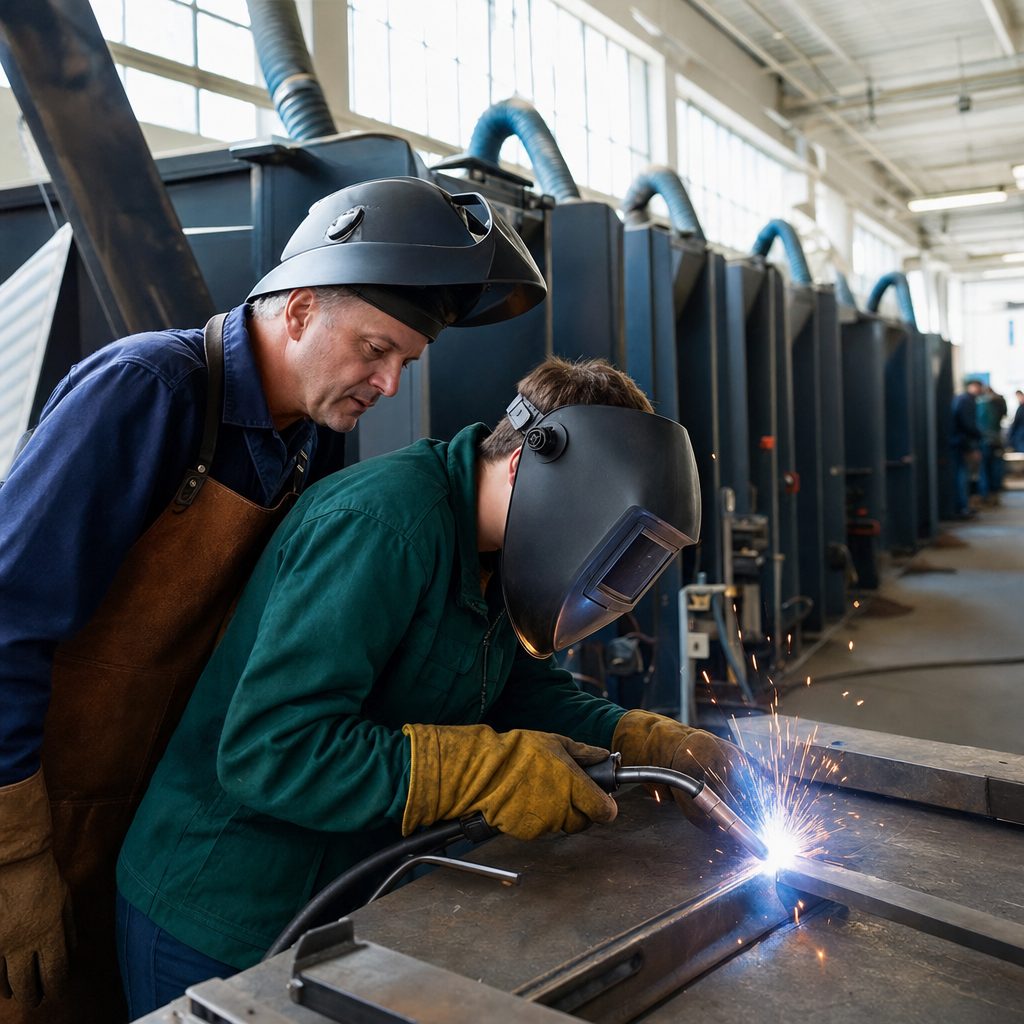
A welding school's defining exposure is not premises slip-and-fall; it is the activity itself. Students stand at live arcs producing 6,000-plus-degree heat, molten spatter, ultraviolet and infrared radiation, and clouds of metal fume, and they do it before they have mastered the very skills that keep a welder safe. The predictable severe losses are participant injury (deep burns, arc-eye/welder's flash, and toxic-fume inhalation) and a fire-or-explosion property catastrophe when sparks or slag reach combustibles, fuel-gas cylinders, or a poorly purged container. Standard education or business-owner policies are written for classrooms, not for a working hot-work shop, and they frequently exclude or sublimit the participating hazard that defines your operation.
Federal hot-work rules treat a welding bay as a fire scene in waiting. Under OSHA's welding, cutting, and brazing standard, combustibles must be relocated at least 35 feet from the work, guards must confine heat and sparks where they cannot be moved, and no hot work may be performed on used containers until they are proven free of flammable residue (see OSHA 29 CFR 1910.252). A single ignored fire watch can produce a building loss, a business interruption, and an injured student in the same incident. Specialized commercial insurance programs are built to respond to that stacked exposure rather than to deny it.
Because students are learners, the school carries the duty to supervise, ventilate, and protect them, and a serious burn or inhalation claim names the school, the instructor, and often the equipment. Coverage has to be scoped to the participant, the shop, and the credential you promise, not to a generic schoolhouse.
- Severe participant injury: third-degree burns from molten metal, slag, and hot stock handling
- Arc-eye / welder's flash and long-term vision injury from unshielded ultraviolet and infrared radiation
- Toxic-fume inhalation claims from manganese, hexavalent chromium, zinc, and shielding-gas exposure
- Fire and explosion: sparks or slag igniting combustibles, oil, or fuel-gas leaks in the shop
- Compressed-gas cylinder rupture or oxy-fuel flashback causing blast and shrapnel injury
- Failure-to-certify and failure-to-place errors-and-omissions allegations from graduates
- Base GL and BOP forms that exclude or sublimit the participating welding hazard
Core Coverages for Welding Schools
The program leads with the two perils that produce six-figure losses: severe participant injury and shop fire/explosion. General liability handles third-party and premises claims, but the participating hazard needs a named participant/student-accident layer and signed participation agreements so a burned or flash-injured student's claim is actually covered rather than excluded. Hot-work property coverage is written with realistic limits for a building that lives inside its own fire exposure, and equipment/inland-marine coverage protects the welders, plasma cutters, positioners, fume extractors, and gas systems that make the school run.
Layered on top is professional liability / educators E&O for failure-to-certify and failure-to-deliver allegations, because a welding school sells a credential outcome, often tied to American Welding Society testing. If a graduate fails an AWS performance test or loses a job because the school's instruction or test prep fell short, that is an E&O exposure, and a products-liability angle can attach to welds students complete on customer or live work. Workers' compensation covers your instructors and staff, who face the same arc, fume, and burn hazards every day, and a surety bond is frequently required to hold a proprietary-school license. A commercial insurance package ties general liability, property, equipment, and umbrella limits together so the fire-plus-injury scenario is funded across one coordinated tower.
Depending on enrollment and operations, we round the stack out with commercial umbrella limits, business interruption to fund payroll and lease while a fire-damaged shop is rebuilt, and cyber/student-data coverage where the school holds enrollment and federal-aid records.
- General liability for premises, third-party bodily injury, and off-site demonstration exposure
- Named participant / student-accident coverage for in-shop burns, flash, and fume injury
- Hot-work commercial property written for a shop carrying its own fire/explosion exposure
- Equipment and inland-marine for welders, plasma cutters, positioners, extractors, and gas systems
- Professional liability / educators E&O for failure-to-certify and failure-to-place claims, plus products liability on student welds
- Workers' compensation for instructors and staff exposed to arc, fume, and burns
- Surety bond for proprietary-school licensure, commercial umbrella, business interruption, and cyber/student-data
Licensing, Compliance & Regulatory Considerations for Welding Schools
A welding school usually answers to two regulatory worlds at once: the state proprietary- or private-occupational-school board that licenses you to enroll and charge tuition, and the federal workplace-safety regime that governs the shop itself. State proprietary-school boards typically require a license, disclosed completion and placement data, and a surety bond or tuition-protection guarantee so students are made whole if the school closes mid-program. Maintaining that bond and the insurance the board mandates is a condition of staying open.
On the shop floor, the school must meet OSHA's hot-work and exposure standards. Fume control is regulated directly: OSHA enforces permissible exposure limits for welding contaminants, including a 5 micrograms-per-cubic-meter limit for hexavalent chromium with feasible engineering and work-practice controls required first (see OSHA's hexavalent chromium exposure controls), which is why ventilation, fume extraction, and respiratory protection are compliance issues, not just good practice. EPA air-quality rules can also reach a shop's exhaust and fume-handling.
On the credentialing side, schools commonly align curricula to the American Welding Society and may run an AWS SENSE program or Accredited Test Facility; AWS is explicit that a SENSE certificate is not the same credential as a Certified Welder qualification (see the AWS Certified Welder Program). Misrepresenting what a graduate will hold is a fast path to a failure-to-certify claim, so marketing language and E&O coverage should match the actual credential.
- State proprietary / private-occupational-school board license, disclosures, and renewal
- Surety bond or tuition-protection guarantee required to hold the school license
- OSHA hot-work compliance: 35-foot combustible clearance, fire watch, guards, and container purging
- OSHA fume exposure limits for hexavalent chromium, manganese, and shielding gases with required controls
- EPA air-quality and emissions rules governing shop exhaust and fume handling
- American Welding Society alignment, SENSE program, or Accredited Test Facility standards
- Accurate representation of SENSE vs. Certified Welder credentials in all marketing and enrollment materials
Why Welding Schools Choose The Allen Thomas Group
The Allen Thomas Group is an independent, family-owned insurance agency founded in 2003 and licensed in 28 states. We are not tied to one carrier, so we shop your welding school's risk across 15-plus A-rated carriers, including markets that understand hot-work property and participant-injury exposure rather than declining it as too hazardous.
Welding schools are an unusual hybrid, part trade school and part working fabrication shop, and most generic agents miss the participating-hazard exclusion or under-limit the fire/explosion property until a claim exposes the gap. We read the policy forms, confirm the participant and hot-work coverage actually responds, and place the surety bond your state board requires.
We hold an A+ BBB rating and act as your advocate, conducting annual coverage reviews as enrollment, equipment, and program offerings grow, and pressing carriers at claim time so a fire-plus-injury loss is funded across the whole tower.
- Independent and family-owned since 2003, never tied to a single carrier
- Licensed in 28 states with access to 15+ A-rated carriers
- Markets that write hot-work property and participant-injury exposure instead of declining it
- Policy-form review to confirm participant, fume, and fire/explosion coverage actually responds
- Surety-bond placement for proprietary-school licensure
- A+ BBB rating and direct claims advocacy on stacked fire-and-injury losses
- Annual reviews as enrollment, equipment values, and AWS programs expand
How Much Does Welding School Insurance Cost?
Premium is driven by the things that make a welding school hazardous: total enrollment and number of booths in use at once, instructor and staff payroll, the building's construction and fire-protection class, the replacement value of welders and gas systems, the mix of processes taught (oxy-fuel and plasma cutting raise the fire/explosion profile), and your loss history for burns, fume claims, and fires. A small adult-only program in a sprinkled masonry shop prices very differently from a large school running dozens of booths and live customer work.
As a planning range, a smaller welding school often sees a general liability and participant-accident package land in the low-to-mid four figures annually, with hot-work commercial property adding meaningfully on top because the building carries its own ignition source. Educators E&O / professional liability for failure-to-certify exposure commonly runs roughly $1,500 to $5,000 a year depending on enrollment and placement claims, and workers' compensation is rated on instructor payroll and welding class codes.
Larger schools with high equipment values, multiple locations, or umbrella limits over a fire-prone shop will see total programs reach the mid five figures. The honest answer is that exact pricing depends on your booth count, payroll, property values, and claims record, which is why we quote it across multiple carriers rather than from a single rate sheet.
- Enrollment, simultaneous booth count, and student-to-instructor ratios
- Instructor and staff payroll and assigned welding workers' comp class codes
- Building construction, sprinklering, and fire-protection class
- Replacement value of welders, plasma/oxy-fuel equipment, extractors, and gas systems
- Processes taught and whether live customer or production work is performed
- Loss history for burns, arc-flash, fume claims, and shop fires
- Limits chosen for hot-work property, umbrella, and educators E&O
Welding School Risk Management & Coverage Considerations
The cheapest claim is the one your safety program prevents, and underwriters price welding schools partly on how seriously you manage the shop. The fundamentals are a written hot-work permit and fire-watch procedure, the 35-foot combustible-clearance rule, fume extraction at each booth with documented respiratory protection, and required personal protective equipment (auto-darkening helmets, leathers, and respirators) enforced before a student strikes an arc. Signed participation agreements and injury waivers that name the welding, cutting, and fume hazards specifically are essential so a burned or flash-injured student's claim is contractually and contractually anchored.
Instructor credentialing matters to both safety and your E&O posture: AWS-qualified instructors, documented competency checks before students progress to higher-risk processes, and supervision ratios that keep an experienced eye on every live arc reduce both injuries and failure-to-certify allegations. Compressed-gas storage, cylinder securing, leak checks, and flashback arrestors should be inspected on a schedule, and an emergency plan covering fire, blast, and eye/burn first aid should be posted and practiced.
Emerging exposures include student-data and FERPA-style obligations if the school participates in federal aid, marketing-language risk where SENSE completion is implied to be a full Certified Welder credential, and products/completed-operations exposure when students perform welds on customer or live work that later fails. We align coverage to each of these rather than assuming a base policy reaches them.
- Written hot-work permit and fire-watch procedure with the 35-foot combustible-clearance rule
- Booth-level fume extraction, ventilation, and documented respiratory protection
- Enforced PPE (auto-darkening helmets, leathers, respirators) before any live arc
- Hazard-specific signed participation agreements and injury waivers for every student
- AWS-qualified instructors, competency gates, and supervision ratios at live booths
- Compressed-gas storage, cylinder securing, flashback arrestors, and leak inspections on schedule
- Accurate SENSE-vs-Certified-Welder marketing, FERPA-style data practices, and products exposure on student welds
Frequently Asked Questions
Does general liability cover a student who is burned or injured while welding?
Often not on its own. Standard general liability and business-owner policies frequently exclude or sublimit the participating hazard, meaning the welding activity itself. A welding school needs named participant or student-accident coverage, backed by signed participation agreements, so that a student's burn, arc-flash, or fume-inhalation claim is actually covered rather than denied as an excluded activity.
Does my policy cover a fire or explosion in the welding shop?
It should, but only if the property coverage is written as hot-work property with realistic limits. A welding shop carries its own ignition source, so generic property limits are often too low. We place commercial property that anticipates spark, slag, fuel-gas, and cylinder exposure, and we add business interruption so payroll and lease are funded while a fire-damaged shop is rebuilt.
Does general liability cover a failure-to-certify or failure-to-place claim?
No. Those are professional liability or educators errors-and-omissions claims. If a graduate fails an AWS performance test, or alleges the school's instruction or job-placement promise fell short, that allegation is handled by E&O coverage, not general liability. A welding school that markets a credential outcome should carry professional liability sized to that promise.
What is the difference between professional liability and general liability for a welding school?
General liability covers bodily injury and property damage to third parties, such as a visitor slipping in the lobby. Professional liability, or educators E&O, covers claims that your instruction, certification prep, or placement promise was negligent or failed to deliver. A welding school needs both because it has a physical shop and sells an educational outcome.
Do I need workers' compensation for my welding instructors?
Almost certainly. Most states require workers' compensation once you have employees, and welding instructors face the same arc, burn, and fume hazards as students every day. Premium is rated on instructor and staff payroll using welding class codes, and the coverage funds medical care and lost wages if an instructor is injured on the job.
Is fume inhalation actually a covered or regulated exposure?
Yes. Welding fume is regulated by OSHA, which enforces permissible exposure limits for contaminants such as hexavalent chromium and manganese and requires engineering controls like ventilation and fume extraction. A school that under-ventilates can face both an OSHA citation and an inhalation-injury claim, so fume exposure should be both controlled in the shop and accounted for in your participant and workers' comp coverage.
Do I need a surety bond to run a welding school?
Usually yes. Most state proprietary or private-occupational-school boards require a surety bond or tuition-protection guarantee as a condition of licensure, so students are protected if the school closes mid-program. We place that bond alongside your liability and property coverage so your licensing requirement and insurance program are handled together.
What drives the cost of welding school insurance the most?
The biggest drivers are enrollment and the number of booths running at once, instructor payroll, the building's construction and fire protection, the replacement value of welding and gas equipment, the processes taught, and your loss history for burns, fume claims, and fires. Because a welding school combines a trade school with a working hot-work shop, we quote it across multiple carriers rather than from a single rate.
Protect Your Welding School From the Arc to the Credential
From a burned student to a shop fire to a graduate's failed AWS certification, your welding school faces risks a generic policy was never built to cover. We compare 15+ A-rated carriers to build a program around your booths, your instructors, and your credential. Call The Allen Thomas Group at (440) 826-3676 to start your review.