
Motorcycle Training School Insurance
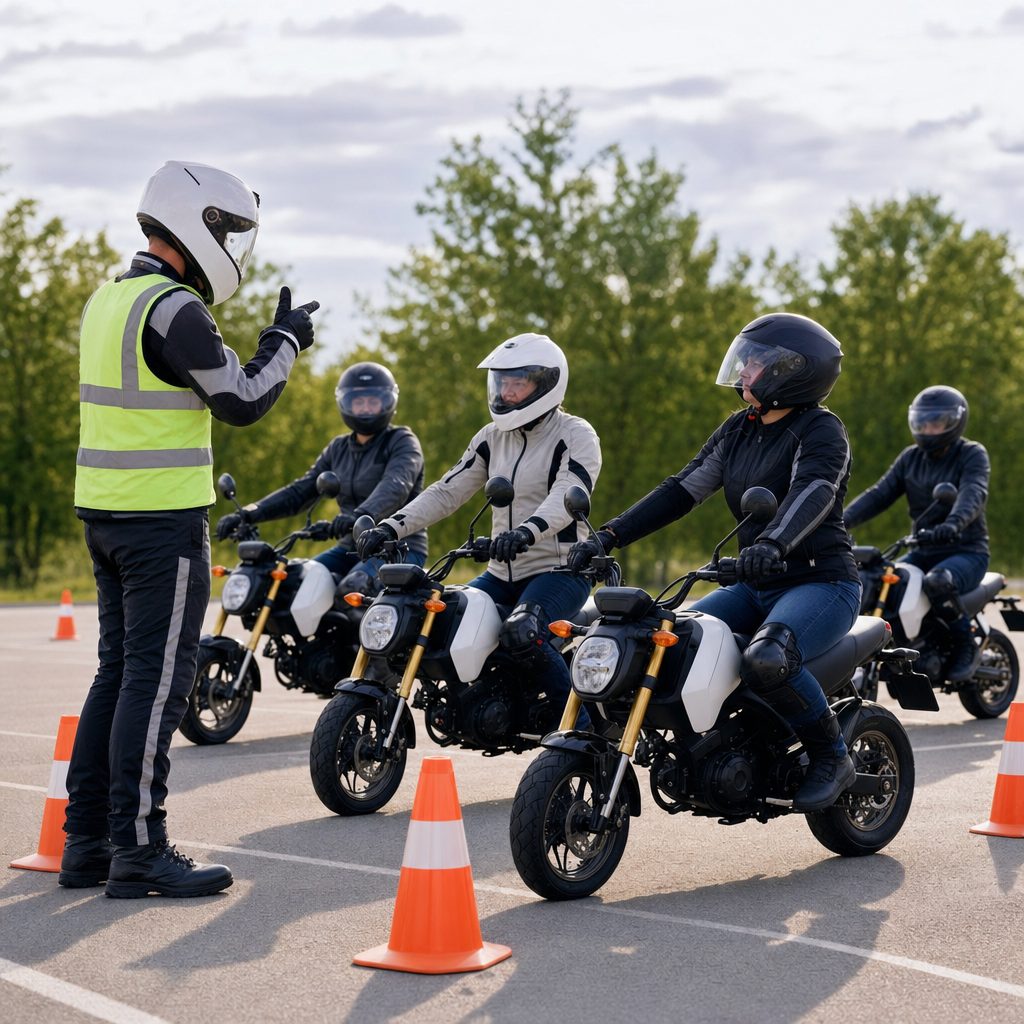
A motorcycle training school puts novice riders on motorcycles in a closed-course range, and the single largest exposure is a catastrophic participant bodily-injury claim. The right program pairs commercial auto for your training fleet with participant accident-medical, instructor E&O, and the high liability and medical-payments limits some states mandate to license a school.
Carriers We Represent
Why Motorcycle Training Schools Need Specialized Insurance
Teaching people to ride a motorcycle is an inherently high-hazard activity, and the defining peril for a rider-education school is catastrophic participant bodily injury. A student who drops a training motorcycle, runs off the range, or collides with another rider during a low-speed exercise can suffer broken bones, head trauma, or worse, and the resulting claim lands squarely on the school. Standard general liability often treats the participating student as an excluded or sublimited exposure because the injury arises from the very activity the student paid to engage in, which is exactly the gap purpose-built motorcycle school programs are designed to close.
The exposure is compounded by the motorcycles themselves. When a school owns and lends training bikes, a student rider is operating a school-owned vehicle, and personal auto policies will not respond to that loss, leaving commercial auto as the only line that covers a training-bike crash on or off the range. Several states also fold a hard insurance mandate into the license itself: Texas, for example, requires a licensed motorcycle safety school to carry at least $2 million in liability coverage plus $10,000 in medical payments, per the Texas Department of Licensing and Regulation.
Because the activity, the vehicles, and the regulator all push the same direction, a motorcycle school needs coordinated commercial insurance programs rather than a generic business owner's policy that quietly excludes its core operation.
- Catastrophic participant bodily-injury risk when novice riders operate training motorcycles on a closed-course range
- General liability frequently excludes or sublimits injuries to the participating student the school is instructing
- School-owned training bikes are not covered by students' personal auto policies, requiring commercial auto
- State licensing can mandate high liability limits plus statutory medical-payments coverage as a condition of operating
- Negligent-instruction and failure-to-certify claims create a professional liability (E&O) exposure distinct from premises GL
- Range collisions between two students implicate multiple injured parties and stacked claims from a single incident
- Off-site road segments, escort rides, and transporting bikes to satellite ranges add hired-and-non-owned auto risk
Core Coverages for Motorcycle Training Schools
The coverage stack for a rider-education school is built around the moving motorcycle. Commercial auto is the lead line: it covers your training motorcycles, any vans or trailers used to haul them, and liability arising from a student operating a school bike. Many schools also carry hired-and-non-owned auto to address rented bikes and instructor vehicles used for school business. Layered above the fleet is a participant accident-medical (student accident) policy that pays a student's medical bills after a range injury on a no-fault basis, which both protects the rider and helps defuse a larger liability claim.
Professional liability, or educators errors-and-omissions, responds when the allegation is bad instruction rather than a slip on the premises: a student claims they were certified despite failing the skills evaluation, that an instructor's coaching caused a crash, or that the school's negligence led to a later road injury. General liability still handles premises slip-and-fall, spectator and parking-lot injuries, and operations off the range, while commercial property and inland marine protect the classroom building, simulators, e-course equipment, and the motorcycles themselves against theft, fire, and damage. Round it out with workers' compensation for instructors and range coaches, and consider EPLI and a commercial umbrella to sit over the auto and GL limits.
Most schools assemble these lines into a single program so the participant, the vehicle, and the instruction exposures are not falling between three different policies. We help motorcycle schools structure that commercial insurance so the closed-course activity is affirmatively covered, not assumed.
- Commercial auto for school-owned training motorcycles, transport vans, and trailers, including student-operated coverage
- Hired-and-non-owned auto for rented bikes and instructor vehicles used on school business
- Participant accident-medical (student accident) coverage that pays range-injury medical bills on a no-fault basis
- Professional liability / educators E&O for negligent-instruction and failure-to-certify allegations
- General liability for premises slip/fall, spectator, and parking-lot injuries off the riding range
- Commercial property and inland marine for the classroom, simulators, e-course equipment, and the motorcycle fleet
- Workers' compensation for instructors and coaches, plus EPLI and a commercial umbrella over auto and GL limits
Licensing, Compliance & Regulatory Considerations for Motorcycle Training Schools
Rider-education content is largely standardized around the Motorcycle Safety Foundation Basic RiderCourse, which pairs roughly five hours of classroom or e-course learning with about ten hours of on-motorcycle range training and concludes with a knowledge test and a skills evaluation. Many states adopt the MSF curriculum and, on completion, waive the DMV written and/or riding test, which makes a school's certification authority a regulated function rather than a private matter.
On top of the curriculum sits a state license. Schools are typically overseen by a state rider-education or motor-vehicle authority, and that body often dictates instructor credentialing, range standards, student-to-coach ratios, and the insurance the school must carry. In Texas the Department of Licensing and Regulation administers the Motorcycle and ATV Operator Safety Program: a motorcycle safety school license is valid for two years, students who bring their own bikes must show liability coverage meeting Texas Transportation Code 601.072, and the school itself must prove at least $2 million in liability plus $10,000 in medical payments. Texas also recently added Section 662.014 to limit the liability of property owners who let schools run instruction on their lots.
Because requirements vary by state, a school operating across state lines should confirm each regulator's curriculum approval, instructor certification, and insurance mandate before enrolling students there.
- MSF Basic RiderCourse is the standard curriculum: ~5 hours classroom/e-course plus ~10 hours of on-motorcycle range training
- Many states waive the DMV written and/or skills test for graduates, making school certification a regulated authority
- A state rider-education or DMV board licenses the school and sets instructor, range, and ratio standards
- Texas TDLR requires a school to carry at least $2 million liability and $10,000 medical payments to be licensed
- Student-owned motorcycles must carry state-minimum liability coverage available for instructor inspection
- Motorcycle safety school licenses are commonly time-limited (e.g., two years in Texas) and must be renewed
- Instructor certification and recertification are typically tied to the adopted curriculum body and the state authority
Why Motorcycle Training Schools Choose The Allen Thomas Group
The Allen Thomas Group is an independent, family-owned insurance agency founded in 2003, licensed in 28 states and backed by 15+ A-rated carriers, with an A+ rating from the Better Business Bureau. We work for the school, not a single carrier, which lets us shop the participant-injury, commercial-auto, and instruction exposures across multiple markets and place the program where the closed-course activity is affirmatively covered.
Rider-education is a niche that generic agents misread, often selling a business owner's policy that excludes the training activity or under-limiting the auto line that has to respond to a student crash. We build the program around your fleet of training motorcycles, your enrollment, and the specific licensing mandate in each state where you teach, then revisit it at annual reviews as you add bikes, ranges, or course offerings.
Our advisory approach means we explain the trade-offs, document the gaps, and advocate at claim time, rather than handing you a policy and walking away.
- Independent, family-owned agency founded in 2003 and licensed in 28 states
- Access to 15+ A-rated carriers, including markets that understand rider-education and participant-injury risk
- A+ rating with the Better Business Bureau and a consultative, non-transactional approach
- Programs structured around your training-bike fleet, enrollment, and each state's licensing insurance mandate
- Annual coverage reviews as you add motorcycles, ranges, instructors, or course types
- Independent advocacy across carriers so the closed-course training activity is affirmatively covered
- Hands-on guidance through licensing insurance requirements and claims advocacy when an incident occurs
How Much Does Motorcycle Training School Insurance Cost?
Premiums for a motorcycle training school are driven primarily by the activity and the fleet rather than by classroom square footage. The biggest factors are the number of training motorcycles, annual student enrollment, the instructor-to-student ratio, the liability and medical-payments limits your state requires, your claims and injury history, and the value of the property and equipment you insure. Schools that also offer advanced or track-oriented courses carry more risk than those teaching only the entry-level Basic RiderCourse.
As rough planning numbers, a small school's general liability often runs about $1,500 to $4,000 a year, while commercial auto on a fleet of training motorcycles and a transport van frequently lands in the $3,000 to $8,000+ range depending on the number of bikes and limits. Participant accident-medical coverage is commonly a few thousand dollars annually and scales with enrollment, professional liability adds roughly $1,000 to $3,000, and workers' compensation depends on instructor payroll. A school in a state mandating $2 million limits will pay more than one with lower statutory minimums.
These are illustrative ranges, not quotes; the only way to price your school accurately is to compare carriers against your actual fleet, enrollment, and state mandate, which is exactly what we do.
- Number of training motorcycles in the fleet and whether transport vans or trailers are insured
- Annual student enrollment and the instructor-to-student ratio maintained on the range
- State-mandated liability and medical-payments limits (e.g., $2M liability + $10K medical in Texas)
- Claims and participant-injury history, which strongly influences the auto and participant-accident pricing
- Course mix: entry-level Basic RiderCourse versus advanced, track, or experienced-rider courses
- Property and equipment values: classroom building, simulators, e-course technology, and the bikes themselves
- Instructor payroll for workers' compensation and the umbrella limit selected over auto and GL
Motorcycle Training School Risk Management & Coverage Considerations
The strongest risk-management lever a rider school has is the participation agreement. Every student should sign a clearly written waiver and assumption-of-risk and informed-consent document before mounting a bike, and the school should keep signed agreements on file alongside proof that student-owned motorcycles meet state liability requirements. Waivers do not replace insurance, but together with named participant/accident-medical coverage they form the intended response to a range injury.
Operationally, schools reduce loss frequency by enforcing full protective gear (DOT helmets, eye protection, gloves, over-the-ankle boots, long sleeves and pants), maintaining low student-to-coach ratios, keeping the range surface clean and clearly coned, and following the curriculum sequence so novices are not advanced past their skill. Disciplined motorcycle maintenance, documented instructor certification and recertification, a written emergency-response and incident-report plan, and weather-hold policies all matter to underwriters and to defending a claim.
Emerging considerations include collecting student data and payments online, which creates a cyber and privacy exposure, and the growth of e-course and simulator delivery, which shifts some risk into technology and equipment your property and cyber coverage should reflect.
- Require signed waiver, assumption-of-risk, and informed-consent participation agreements before any range time
- Verify and retain proof that student-owned motorcycles carry state-minimum liability coverage
- Enforce full protective gear: DOT helmet, eye protection, gloves, over-the-ankle boots, long sleeves and pants
- Maintain low student-to-coach ratios and a clean, clearly coned range surface following the curriculum sequence
- Document instructor certification/recertification and keep a written emergency-response and incident-report plan
- Inspect and maintain the training-motorcycle fleet on a documented schedule with weather-hold policies
- Protect online enrollment and payment data (cyber/privacy) and insure simulators and e-course technology
Frequently Asked Questions
Does general liability cover a student who is injured riding a training motorcycle?
Often not on its own. General liability frequently excludes or sublimits bodily injury to the participating student because the injury arises from the very activity the student paid to do. Motorcycle schools close that gap with named participant/accident-medical coverage and, because a school-owned bike is involved, commercial auto. Relying on GL alone usually leaves the catastrophic range-injury claim uncovered.
Why do I need commercial auto when students are only riding in a parking lot?
Because the student is operating a school-owned motorcycle. A personal auto policy will not respond to a crash on a vehicle the school owns, and the activity is a business use, so commercial auto is the line that covers training-bike liability and damage. It also covers your transport vans and trailers, and hired-and-non-owned auto can extend to rented bikes and instructor vehicles used for school business.
What is the difference between professional liability and general liability for a rider school?
General liability handles premises and bodily-injury claims like a spectator slipping in the parking lot. Professional liability, or educators E&O, responds when the allegation is about the instruction itself, such as negligent coaching, certifying a student who failed the skills test, or a failure-to-deliver on a promised outcome. Most schools need both because the exposures are distinct.
Are there state-required insurance limits to license a motorcycle school?
In some states, yes. Texas, for example, requires a licensed motorcycle safety school to carry at least $2 million in liability coverage plus $10,000 in medical payments through the Texas Department of Licensing and Regulation. Requirements vary by state, so confirm each rider-education or DMV authority's mandate before enrolling students in that state.
Do I need workers' compensation for my instructors and range coaches?
If you have employees, most states require workers' compensation, and it is especially important for a physically active, outdoor role like range coaching where an instructor could be struck by a student's bike or injured demonstrating a maneuver. Even where instructors are contractors, carriers and states scrutinize classification, so confirm your obligations rather than assuming an exemption.
Does my coverage extend to transporting motorcycles to off-site or satellite ranges?
It can, if the program is built for it. Commercial auto covers your owned vans and trailers hauling bikes, and hired-and-non-owned auto can pick up rented transport or instructor vehicles used for school business. Tell your agent about every range and transport pattern so the auto coverage and limits reflect the actual operation rather than a single home location.
What drives the cost of motorcycle training school insurance?
The main drivers are the number of training motorcycles, annual student enrollment, the instructor-to-student ratio, the liability and medical-payments limits your state mandates, your claims and injury history, the course mix (basic versus advanced or track courses), and the value of your property and equipment. A state requiring $2 million limits will cost more than one with lower statutory minimums.
Do signed waivers replace the need for insurance?
No. A well-drafted waiver, assumption-of-risk, and informed-consent participation agreement is essential risk management and helps defend a claim, but waivers can be challenged and do not pay medical bills or defense costs. Schools pair signed participation agreements with participant/accident-medical coverage and liability insurance so there is an actual funding source when a rider is hurt.
Protect Your Riders and Your Rider-Education School
We compare 15+ A-rated carriers to build a motorcycle training school program around your fleet, your enrollment, and your state's licensing mandate, so the closed-course activity is affirmatively covered. Call The Allen Thomas Group at (440) 826-3676 for an independent review of your coverage.