
Demolition Contractor Insurance: Coverage Built for High-Hazard Wrecking and Dismantling Work
The Allen Thomas Group is an independent, family-owned insurance agency, licensed since 2003, that builds demolition contractor insurance programs around the real hazards of wrecking and dismantling work: flying debris, structural collapse, dust and asbestos exposure, and heavy equipment risk. We shop your coverage, general liability, contractors pollution liability, workers compensation, commercial auto, and equipment coverage, across 15+ A-rated carriers and specialized high-hazard underwriters, licensed in 28 states.
Carriers We Work With
Last Updated: September 29, 2026
What Is Demolition Contractor Insurance?
Demolition contractor insurance is a package of commercial policies built for wrecking and dismantling businesses, protecting against third-party property damage, bodily injury, and equipment loss. Standard general liability policies for this trade typically start at $1,000,000 per occurrence and $2,000,000 aggregate, higher than most general contracting classes, because demolition work carries elevated explosion, collapse, and underground (XCU) exposure. A general liability policy covers the flying debris that hits a parked car or a neighboring structure. Workers compensation covers a crew member hurt by falling debris or a partial collapse. Contractors pollution liability covers the dust and asbestos-related cleanup claims that general liability excludes entirely.
The right program depends on the methods used (mechanical demolition, hand demolition, or high-hazard methods like wrecking balls and explosives), the type and age of structures taken down, and whether the work is residential, commercial, or government contracting. Commercial and government projects routinely require higher limits than any state licensing rule demands.
Why Wrecking and Dismantling Work Carries Higher Insurance Costs Than General Contracting
Underwriters treat demolition as a distinct, higher-hazard class from general contracting. OSHA's demolition standard, 29 CFR 1926 Subpart T, sets specific safety requirements for site preparation, material removal, and mechanized demolition precisely because this work carries risks that ordinary construction does not.
Explosion, Collapse, and Underground (XCU) Exposure
Wrecking and dismantling a structure carries risk of partial or total collapse in an unplanned direction, damage to adjoining buildings, and underground utility strikes during foundation removal. Standard contractor policies are underwritten assuming controlled, additive construction, not the removal of a structure's load-bearing elements, which is why many exclude this exposure entirely unless specifically added.
Dust, Lead, and Asbestos Exposure in Older Structures
Demolishing a structure built before the 1980s routinely disturbs asbestos-containing materials and lead paint. OSHA's asbestos standard, 29 CFR 1926.1101, specifically classifies demolition and salvage of asbestos-containing structures as regulated work requiring engineering controls, respiratory protection, and decontamination procedures. A dust or asbestos claim without contractors pollution liability can exceed the value of the entire demolition contract.
High-Value Equipment and Debris-Hauling Vehicles
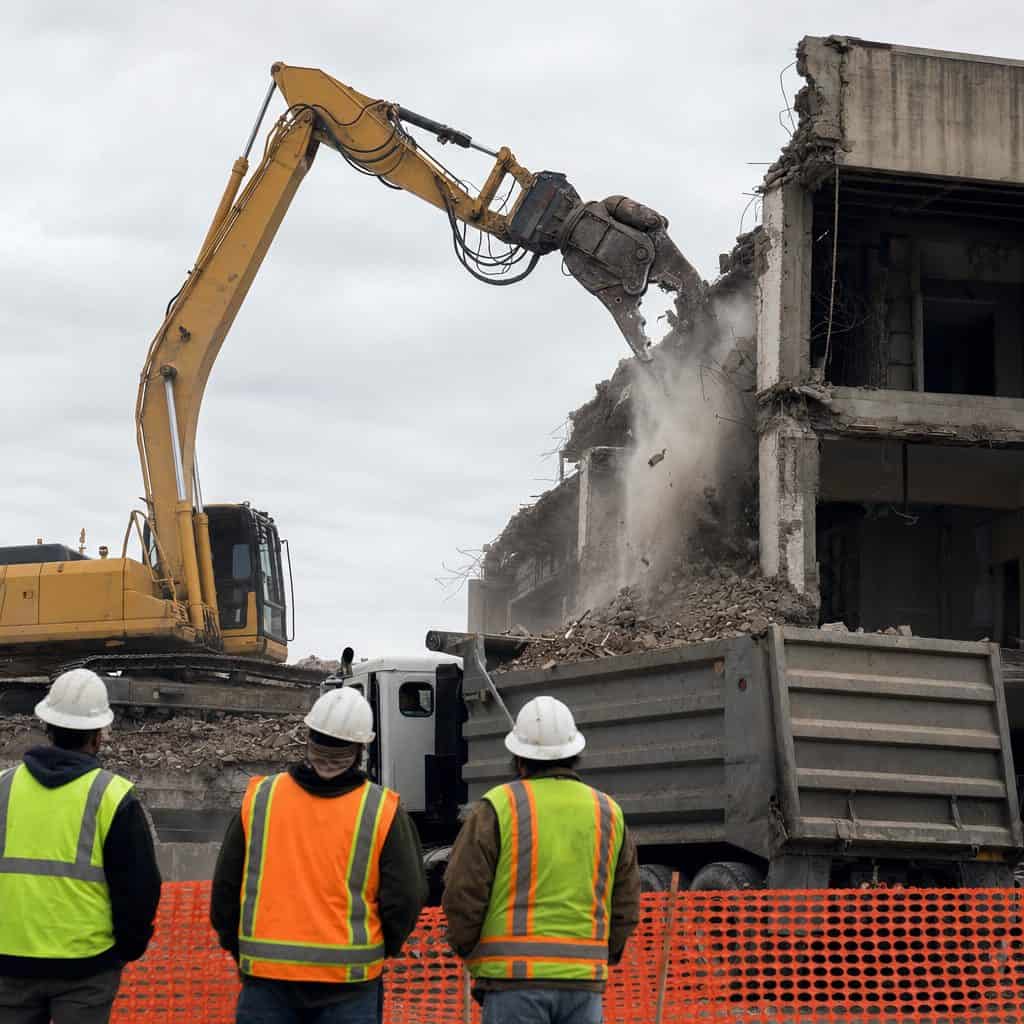
Excavators, hydraulic shears, and rented specialty attachments represent a significant capital investment sitting on an active job site, and dump trucks hauling debris carry their own commercial auto exposure. Both are common theft and physical-damage claims distinct from the liability risk of the demolition work itself.
Core Insurance Policies Every Demolition Business Should Carry
Commercial General Liability (CGL)
General liability is the foundational coverage for any demolition business. It covers third-party bodily injury, third-party property damage, and legal defense costs, the flying debris that hits a car or damages an adjoining building. Standard limits start at $1 million per occurrence and $2 million aggregate, with commercial and government projects frequently requiring $2 million to $5 million or higher through an umbrella policy.
Contractors Pollution Liability
Standard general liability policies contain a pollution exclusion that applies broadly to contamination claims. Contractors pollution liability fills that gap for demolition work specifically, covering environmental damage and dust, lead, or asbestos-related cleanup claims that arise from tearing down a structure.
Workers Compensation Insurance
Workers compensation is required in most states for any demolition business with employees. It covers medical bills and lost wages for a crew member injured by falling debris, structural collapse, or heavy equipment. Demolition carries some of the highest workers compensation classification rates of any commercial trade.
Inland Marine (Equipment) Insurance
Excavators, hydraulic shears, and rented tools represent significant capital investment. Inland marine coverage protects this equipment from theft or on-site damage whether it is owned or rented, in transit, or sitting on an active job site.
Commercial Auto Insurance
Company trucks, dump trucks, and debris-hauling vehicles titled in the business name require commercial auto coverage. Personal auto policies exclude business use, leaving the business and driver exposed after a work-related accident.
Commercial Umbrella Insurance
Commercial and government demolition contracts frequently require $2 million to $5 million or higher in combined liability limits. Umbrella coverage extends the limits of general liability, employer's liability, and commercial auto once primary policy limits are exhausted, meeting these contract requirements without inflating every underlying policy's limit individually.
How Much Does Demolition Contractor Insurance Cost?
A small demolition operation with no employees typically pays $3,000 to $6,000 per year for general liability alone, with $1 million per occurrence and $2 million aggregate as the standard starting limit. A demolition company with employees carrying general liability, workers compensation, contractors pollution liability, and commercial auto together can expect combined annual premiums of $28,000 to $55,000 or more, depending on payroll, equipment value, and whether the work includes structural or high-rise demolition.
| Policy | Avg Monthly Cost | Avg Annual Cost | Typical Limit |
|---|---|---|---|
| General Liability | $385 | $4,620 | $1M / $2M aggregate |
| Contractors Pollution Liability | $215 | $2,580 | $1M / $2M aggregate |
| Workers Compensation | $985 | $11,820 | Statutory |
| Commercial Auto | $345 | $4,140 | $1M CSL |
| Inland Marine (Equipment) | $265 | $3,180 | Varies |
| Commercial Umbrella | $415 | $4,980 | $2M–$5M |
These are industry averages, not quotes. A demolition contractor doing structural or high-rise work, using wrecking balls or explosives, or with prior claims will pay more than the averages above, and may require a specialized high-hazard underwriter rather than a standard commercial carrier.
Key factors that drive demolition premiums higher than the averages above:
- Structural or high-rise demolition versus interior strip-out or selective demolition
- Use of wrecking balls, explosives, or other high-hazard methods
- Age of structures demolished (asbestos and lead exposure risk)
- Payroll growth and crew size (workers compensation scales directly with payroll)
- Prior property damage, pollution, or injury claims in the last three to five years
How The Allen Thomas Group Can Help You
If you run a demolition or wrecking business, whether you do interior strip-outs or full structural takedowns, The Allen Thomas Group shops your coverage across 15+ A-rated carriers and specialized high-hazard underwriters instead of presenting a single company's take-it-or-leave-it quote. We handle the demolition supplemental application and questionnaire on your behalf so your program is placed with a carrier that actually understands this work.
What Is a Demolition Supplemental Application?
Most standard contractor insurance applications do not ask the questions an underwriter needs to price demolition work accurately, which is why carriers require a separate demolition supplemental application before quoting this class of risk. Expect to provide:
- Types and ages of structures typically demolished
- Methods used: mechanical, hand demolition, wrecking ball, or explosives
- Whether asbestos or lead abatement is performed in-house or subcontracted
- Safety program documentation and employee training records
- Prior losses and claims history for the past three to five years
- Annual payroll, revenue, and typical project size
The demolition questionnaire is the specific portion of this application addressing how the work is actually performed. Underwriters use the answers to decide whether a risk fits a standard commercial program or needs placement with a specialized high-hazard underwriter, and the accuracy of these answers directly affects both the premium quoted and whether a future claim is covered without dispute.
Insurance and Bonding Requirements for Wrecking Contractors
Most commercial and government demolition contracts require $2,000,000 to $5,000,000 or higher in combined general liability and umbrella limits, proof of active workers compensation, and contractors pollution liability carried with its own separate limit rather than folded into general liability. Project owners commonly require a certificate of insurance naming them as an additional insured before a crew is allowed on site.
Several states require a demolition-specific contractor license separate from a general contracting license, and some tie a bond requirement to that license. Licensing and bonding requirements vary by state and are separate from insurance requirements, so confirm both before bidding a demolition project in a new jurisdiction.
Common Claims in This Trade and How Coverage Responds
Scenario 1: Flying Debris Damages a Parked Vehicle
During mechanical demolition of a commercial building, debris strikes and totals a vehicle parked on an adjacent street. Repair and replacement costs run to $32,000. This falls under the general liability policy's property damage coverage, since the loss occurred as a direct result of the demolition work in progress.
Scenario 2: Asbestos Disturbance Triggers a Cleanup Claim
Demolition of a 1960s-era structure disturbs asbestos-containing material that was not identified in the pre-demolition survey. Environmental remediation and cleanup costs reach six figures. Because this is a pollution and contamination claim, it falls to contractors pollution liability, not general liability, which excludes this exposure.
Scenario 3: A Crew Member Is Injured by a Partial Collapse
A section of wall collapses earlier than planned during a mechanical takedown, injuring a ground crew member. Workers compensation covers medical bills and a portion of lost wages, and it protects the company from a lawsuit the injured employee might otherwise bring directly.
Scenario 4: A Rented Excavator Is Damaged on Site
A rented excavator is damaged when debris shifts unexpectedly during a takedown. Because the equipment was on a job site rather than at a fixed business location, this loss falls under inland marine (equipment) coverage rather than standard commercial property insurance.
Frequently Asked Questions
What kind of insurance does a demolition contractor need?
Most demolition contractors need commercial general liability as the foundation, plus workers compensation for any crew member on site. Contractors pollution liability covers dust, asbestos, and lead cleanup claims that general liability excludes. Inland marine covers excavators, shears, and rented equipment, and commercial auto covers dump trucks and debris-hauling vehicles.
What does demolition insurance coverage actually include?
A complete demolition insurance program typically includes commercial general liability for third-party injury and property damage, contractors pollution liability for environmental and asbestos-related claims, workers compensation, inland marine for owned and rented equipment, and commercial auto for company vehicles. Commercial and government projects frequently add umbrella or excess liability on top of these base policies.
How much does demolition contractor insurance cost?
A small demolition operation typically pays $3,000 to $6,000 per year for general liability alone, with $1,000,000 per occurrence and $2,000,000 aggregate as the standard starting limit. A company with employees carrying general liability, workers compensation, contractors pollution liability, and commercial auto together can expect combined annual premiums of $28,000 to $55,000 or more, driven by payroll, equipment value, and whether the work includes structural or high-rise demolition.
What are the insurance requirements for demolition contractors?
Most commercial and government demolition contracts require $2,000,000 to $5,000,000 or higher in combined general liability and umbrella limits, proof of workers compensation, and contractors pollution liability with its own separate limit. Many states require a demolition-specific contractor license, and most project owners require a certificate of insurance naming them as an additional insured before work begins.
What is a demolition supplemental application?
A demolition supplemental application is a separate underwriting form beyond a standard contractor application. Underwriters use it to collect details a general contractor application does not ask for: the types of structures demolished, methods used, whether the work involves asbestos abatement, prior losses, and the safety program in place. Most standard contractor programs exclude structural demolition entirely unless this supplemental information is submitted and specifically underwritten.
What is a demolition questionnaire and why do underwriters require one?
A demolition questionnaire is the set of underwriting questions specifically about how demolition work is performed: mechanical versus hand demolition, use of wrecking balls or explosives, height and type of structures taken down, and asbestos or hazardous material protocols. Underwriters use the answers to decide whether a risk fits a standard program or needs a specialized high-hazard carrier, and to set the actual premium and limits offered.
What makes one demolition contractor insurance policy or agency the best fit for my business?
The best fit is not the cheapest quote. It is a program placed with a carrier that actually understands demolition risk rather than one that excludes it after a claim. An independent agency that can access both standard A-rated carriers and specialized high-hazard underwriters, and that fills out the supplemental application and questionnaire accurately on your behalf, is generally better positioned to find coverage that actually responds when a claim happens.
Does standard contractor insurance cover wrecking balls or blasting and explosive demolition?
Usually not. Standard contractor general liability policies commonly exclude high-hazard demolition methods like wrecking balls and explosive or blasting demolition unless a specialized rider is added by an underwriter that writes this class of risk. Confirm with your broker whether your specific methods are covered before relying on a standard policy for this type of work.
Do I need pollution liability if I am not doing environmental remediation work?
Yes, in most cases. Contractors pollution liability is not just for remediation specialists. Standard demolition work routinely disturbs dust, lead paint, and asbestos-containing materials in older structures, and standard general liability policies exclude pollution-related claims. A single dust or asbestos claim without this coverage can exceed the entire value of a demolition contract.
Does workers compensation cover injuries from falling debris or structural collapse?
Yes. Workers compensation covers medical bills and a portion of lost wages for an employee injured by falling debris, a partial structural collapse, or equipment during demolition work. Demolition carries some of the highest workers compensation classification rates of any commercial trade because of the severity potential of these exposures.
Protect Your Next Demolition Project
The Allen Thomas Group is an independent, family-owned broker licensed in 28 states with access to 15+ A-rated carriers and specialized high-hazard underwriters. One call gets you competitive rates from across the market, not a single carrier's take-it-or-leave-it quote. Certificates of insurance issued same day for active policies.