
Cheerleading Gym Insurance
A competitive cheer gym trains young athletes to throw basket tosses, build pyramids, and tumble at speed, and that puts catastrophic head and spinal injury at the center of your risk. The Allen Thomas Group builds coverage programs around the stunt, the participant, and the minors in your building, so a single bad landing or allegation does not end your gym.
Carriers We Represent
Why Cheerleading Gyms Need Specialized Insurance
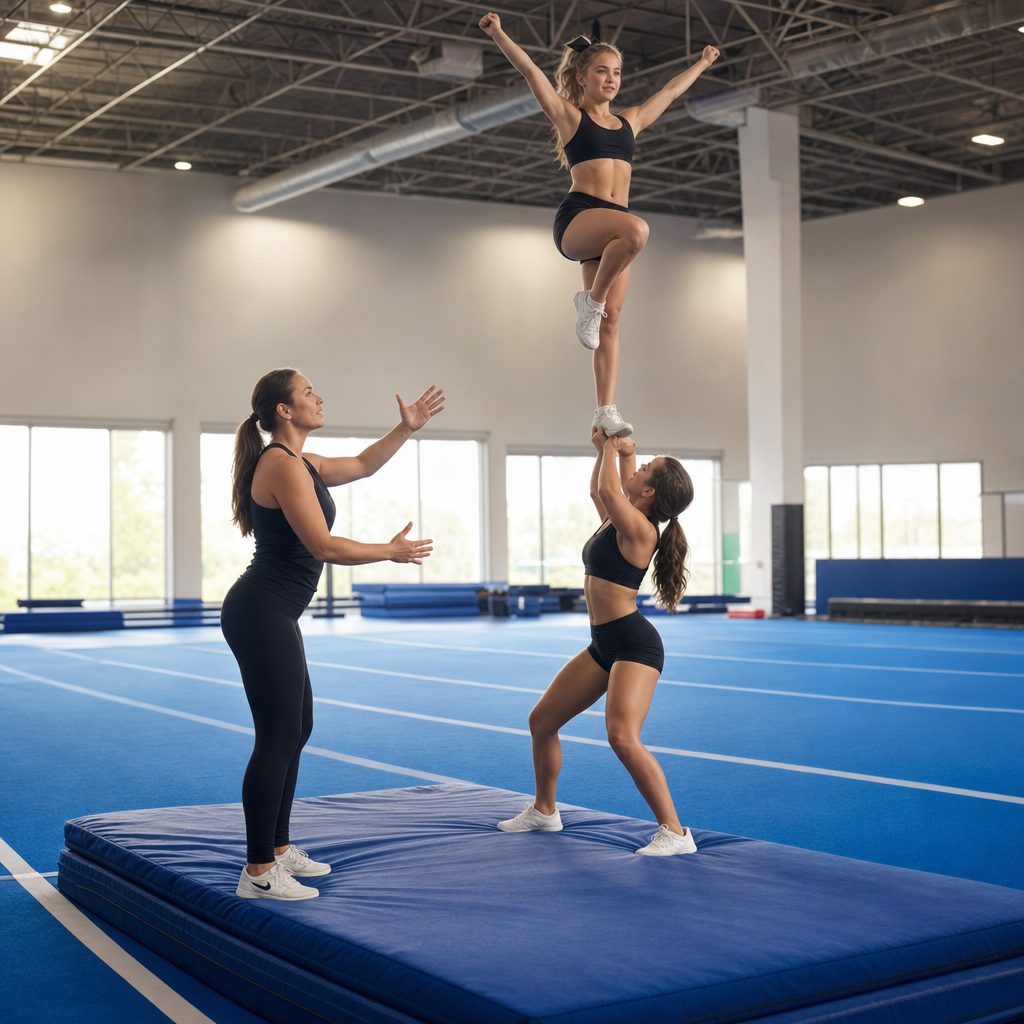
Competitive cheer is one of the few youth activities where the core skill is deliberately throwing a person into the air. Basket tosses, extended pyramids, and elite tumbling concentrate catastrophic risk in the head and cervical spine: research compiled by the National Center for Catastrophic Sport Injury Research found that across 54 catastrophic cheerleading injuries, 52% involved the head and 32% the cervical spine, with basket tosses alone accounting for 35% of catastrophic injuries (see the peer-reviewed analysis of catastrophic cheerleading injuries). A spring floor and trained spotters reduce frequency, but they do not change the severity when something goes wrong.
That severity is exactly what a standard general liability policy is built to dodge. Many GL and BOP forms exclude or sublimit the participating-athlete injury that is your everyday activity, which is why named participant accident-medical coverage and a properly structured catastrophic accident-medical limit matter more here than premises liability ever will. Allen Thomas Group designs commercial insurance programs commercial insurance programs that pair athlete-injury coverage with the liability and property protection a gym actually runs on.
Because your athletes are overwhelmingly minors, the second defining exposure is abuse and molestation. A&M is in a hard market, is frequently excluded from base GL or sublimited to as little as $25,000, and drives some of the largest losses in youth-serving organizations, so it has to be priced and placed deliberately rather than assumed inside the GL form.
- Catastrophic head and cervical-spine injury from basket tosses, pyramids, and tumbling is the gym's signature peril
- Standard GL/BOP forms commonly exclude or sublimit participant (athlete) injury, leaving your daily activity uncovered
- Catastrophic accident-medical with a meaningful limit covers an injured athlete regardless of who is at fault
- Abuse & molestation is frequently excluded or sublimited and must be addressed separately for a minors-facing gym
- Signed waivers and participation agreements support, but do not replace, named participant coverage
- Spring floors, mats, and aerial skills create both an injury exposure and a high-value property exposure
- Travel to competitions adds hired & non-owned auto and out-of-state liability exposure
Core Coverages for Cheerleading Gyms
The lead coverage for a cheer gym is participant injury. Catastrophic accident-medical, paired with a primary or excess accident-medical (A&M) plan for your enrolled minors, responds to the broken wrist or the spinal injury without a fight over negligence, and it is the coverage parents and competition organizers most expect you to carry. This sits on top of, not inside, your general liability.
Around that spine you build the rest of the stack. General liability handles spectators, slip-and-falls, and premises claims; abuse & molestation coverage (endorsed or standalone) closes the gap that GL leaves for a minors program; commercial property protects your building, spring floors, stunt mats, and equipment at replacement cost; and workers' compensation covers coaches and staff who are themselves spotting and lifting all day. Travel to competitions is handled through hired & non-owned auto (HNOA) for coaches and parents driving on the gym's behalf. You can see how these pieces fit within ATG's broader commercial insurance offering.
Rounding out the program: a commercial umbrella to lift limits for catastrophic claims, EPLI as your coaching staff grows, cyber/data coverage for the registration and payment data you collect on families, and professional liability where you offer formal instruction, certification, or private coaching.
- Catastrophic accident-medical and athlete accident-medical (A&M) for enrolled minors — the lead coverage
- General liability for spectators, premises, and slip/fall exposures
- Abuse & molestation coverage (endorsed or standalone) for a minors-facing gym
- Commercial property covering the building, spring floors, stunt mats, and equipment
- Workers' compensation for coaches and staff who spot, lift, and tumble
- Hired & non-owned auto (HNOA) for travel to competitions and events
- Commercial umbrella, EPLI, cyber/student-data, and professional liability to round out the stack
Licensing, Compliance & Regulatory Considerations for Cheerleading Gyms
All-star and competitive cheer gyms are governed less by a single state agency than by the sport's national bodies. The U.S. All Star Federation (USASF) sets the rules, age grids, and event-sanctioning standards that define what stunts and surfaces are permitted, including the requirement that tosses, pyramids, and tumbling be performed only on appropriate surfaces and never on concrete or uneven ground (see the USASF Cheer Rules). USA Cheer serves as the national governing body and publishes the SafeSport-aligned safety program your insurer will expect you to follow.
Athlete-protection compliance is the piece most directly tied to your abuse coverage. USA Cheer mandates minor athlete abuse-prevention training and adopts policies aligned with the U.S. Center for SafeSport, including limits on one-on-one adult-minor contact. Carriers writing A&M coverage will often condition or price the policy on whether your staff are SafeSport-trained and background-checked.
Layered on top are ordinary commercial obligations: local occupancy and building codes for your facility, employee classification and workers' compensation under your state's rules, and the affiliation or sanctioning agreements with USASF and competition producers that frequently carry their own insurance and additional-insured requirements.
- USASF rules, age grids, and event-sanctioning standards govern permitted stunts and practice surfaces
- USA Cheer is the national governing body and publishes the sport's SafeSport-aligned safety program
- USA Cheer mandates minor athlete abuse-prevention training and SafeSport-aligned conduct policies
- Staff background checks and SafeSport training are often conditions of abuse & molestation coverage
- Competition producers and USASF sanctioning typically impose additional-insured and limit requirements
- Local building, occupancy, and fire-code compliance applies to your gym facility
- State workers' compensation rules apply to coaching and front-desk staff
Why Cheerleading Gyms Choose The Allen Thomas Group
The Allen Thomas Group is a family-owned, independent insurance agency founded in 2003 and licensed in 28 states. We are not tied to one carrier, so we shop your gym across 15+ A-rated insurers and place coverage with the markets that actually understand catastrophic participant risk, abuse exposure, and youth-sports operations.
That independence matters most on the coverages that make or break a cheer gym: getting a real catastrophic accident-medical limit instead of a token sublimit, securing genuine abuse & molestation coverage rather than a $25,000 afterthought, and insuring spring floors and mats at replacement cost. We hold an A+ BBB rating and act as your advocate at renewal and at claim time, not as an order-taker.
We review your program annually as your enrollment, competition travel, and coaching roster change, and we tap education and specialty-sport carriers most generalist agents never access, so your coverage keeps pace with how your gym actually operates.
- Family-owned, independent agency founded in 2003, licensed in 28 states
- Access to 15+ A-rated carriers, including education and specialty-sport markets
- A+ BBB rating and a track record of advocacy at renewal and at claim time
- Real catastrophic accident-medical and abuse limits, not token sublimits
- Spring floors, mats, and equipment insured at appropriate replacement values
- Annual program reviews as enrollment, travel, and staffing change
- Independent advice with no obligation to any single insurer
How Much Does Cheerleading Gym Insurance Cost?
There is no flat rate for a cheer gym, because premium is driven by the things that drive injury and abuse risk: total athlete enrollment, the number of coaches and the payroll behind them, the skill level you compete at (a rec tumbling program prices very differently from an elite Worlds team throwing basket tosses), your building and equipment values, your competition travel, and your claims and abuse-allegation history.
As a directional benchmark, a small gym can often place a general liability policy in the range of roughly $1,500 to $4,000 per year, with athlete accident-medical (A&M) frequently added on a per-athlete basis. Abuse & molestation coverage, commercial property on a building full of spring floors and mats, workers' compensation for coaching staff, and umbrella limits are priced separately and can bring a mid-size competitive gym's total program into the mid four figures and up.
The most reliable way to control cost is documented safety: SafeSport-trained and background-checked staff, enforced supervision ratios, maintained equipment, and a clean loss history all give underwriters reasons to price you favorably rather than defensively.
- Athlete enrollment and the number of teams/classes you run
- Coaching headcount and payroll (the basis for workers' compensation)
- Competition level — elite stunting and tumbling rate higher than rec programs
- Building, spring-floor, mat, and equipment replacement values
- Competition travel and hired & non-owned auto exposure
- Prior claims, injury, and abuse-allegation history
- Safety posture: SafeSport training, background checks, and supervision ratios
Cheerleading Gym Risk Management & Coverage Considerations
Your insurance program is only as strong as the practices behind it, and underwriters know it. The single highest-leverage step against your abuse exposure is a two-adult rule that eliminates one-on-one adult-minor situations, paired with criminal background checks and SafeSport training for every coach and volunteer. These are exactly the controls carriers look for before extending meaningful abuse & molestation limits.
On the injury side, enforce signed waivers and participation agreements for every athlete, maintain appropriate spotter and supervision ratios for stunting and tumbling, follow USASF surface and skill-progression rules, and keep spring floors and mats inspected and on a replacement schedule. Document an emergency action plan and concussion protocol, because catastrophic cheer injuries cluster in the head and cervical spine and response time matters.
Finally, treat the data you collect like the liability it is: registration, payment, and minors' information should be secured with reasonable cyber hygiene, and your travel-to-competition logistics should be governed by a clear transportation policy covering who drives, in what, and under whose insurance.
- Enforce a two-adult rule and eliminate one-on-one adult-minor contact
- Require criminal background checks and SafeSport training for all coaches and volunteers
- Collect signed waivers and participation agreements from every athlete/family
- Maintain spotter and supervision ratios and follow USASF skill-progression rules
- Inspect and replace spring floors and mats on a documented schedule
- Keep a written emergency action plan and concussion protocol on file
- Secure registration/payment/minor data and set a clear competition-travel policy
Frequently Asked Questions
Does general liability cover an athlete's injury at a cheer gym?
Often not. Most general liability and business owners policies exclude or sublimit injury to a participating athlete, which is the gym's everyday exposure. That is why named participant accident-medical and catastrophic accident-medical coverage are placed separately and treated as the lead coverages for a cheer gym.
Does general liability cover abuse or molestation claims?
Usually not in a meaningful way. Abuse & molestation is frequently excluded from base GL or sublimited to as little as $25,000. Because your athletes are minors, you generally need an endorsed or standalone abuse & molestation limit, which carriers often condition on SafeSport training and background checks for staff.
What is catastrophic accident-medical coverage and why does it matter for cheer?
It is a high-limit medical coverage that responds to a severe injury, such as a head or spinal injury from a fall, regardless of who was at fault. Catastrophic cheer injuries concentrate in the head and cervical spine, so a real catastrophic limit, rather than a token sublimit, is one of the most important coverages a competitive gym can carry.
Do waivers and participation agreements replace insurance?
No. Signed waivers and participation agreements are important and support your defense, but they do not pay an injured athlete's bills and can be challenged, especially when minors are involved. They work alongside accident-medical and liability coverage, not in place of it.
Is professional liability or general liability more important for a cheer gym?
They cover different things. General liability handles premises and bystander claims, while professional liability responds to claims arising from your instruction or coaching. For a competitive gym, the true priority sits with participant accident-medical and abuse coverage, with GL and professional liability supporting the program.
Do I need workers' compensation for my coaches?
In most states, yes, once you have employees. Coaches spot, lift, and tumble all day, so they face real injury risk themselves, and workers' compensation covers their medical costs and lost wages while protecting the gym from related lawsuits. Premium is based on coaching payroll.
How is coverage handled when we travel to competitions?
Travel adds out-of-state liability and auto exposure. Hired & non-owned auto (HNOA) coverage responds when coaches or parents drive on the gym's behalf, and your general liability should be confirmed to apply at sanctioned events. Competition producers often also require you to add them as an additional insured.
What makes cheer gym insurance more expensive than a typical kids' activity?
The combination of catastrophic injury potential from stunting and tumbling and the abuse exposure that comes with serving minors. Premium is driven by enrollment, coaching payroll, competition level, equipment and building values, travel, and claims history, with documented SafeSport training and safety controls helping to lower the rate.
Protect Your Cheer Gym, Your Athletes, and Your Coaches
Let The Allen Thomas Group compare 15+ A-rated carriers to build a program around catastrophic accident-medical, abuse coverage, and your spring floors and mats. Call (440) 826-3676 for an independent review tailored to your competitive cheer gym.