
Cosmetology & Barber School Insurance
A cosmetology or barber school is unlike any other classroom: your students practice color, cuts, chemical relaxers, facials, waxing, and manicures on paying members of the public long before they are licensed. That supervised clinic floor is where most schools generate revenue — and where the school's deepest liability lives. The Allen Thomas Group builds insurance programs around that student-on-public exposure, not around a working salon's risks.
Carriers We Represent
Why Cosmetology & Barber Schools Need Specialized Insurance
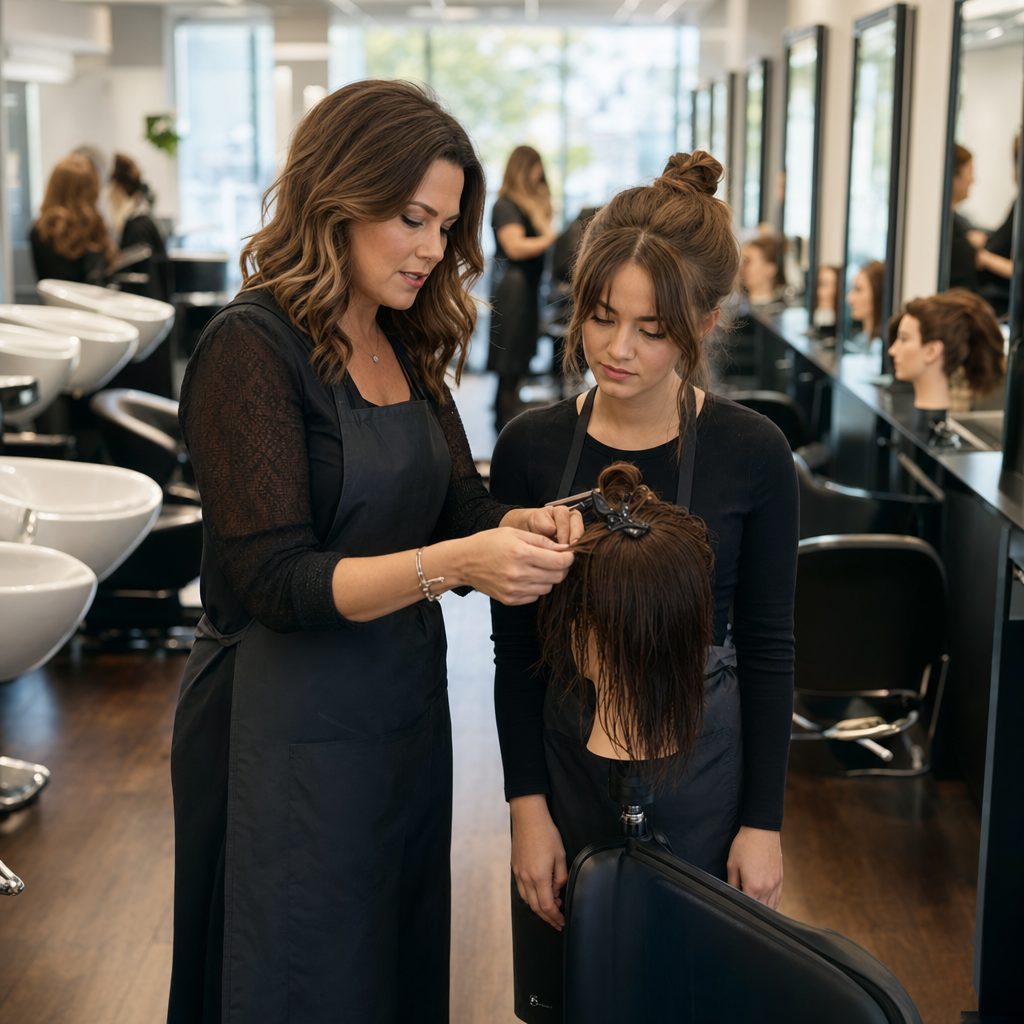
The defining risk at a cosmetology or barber school is the public clinic floor: under instructor supervision, your students perform haircuts, color, perms, chemical relaxers, facials, chemical peels, waxing, and nail services on paying clients who are knowingly being worked on by trainees. When a student causes a chemical burn, an allergic reaction to a dye or relaxer, a laceration from shears or a razor, or a wax burn, the injured client looks past the student to the school that supervised, trained, and profited from the service. That is a professional liability and products liability claim layered on top of ordinary premises risk — a combination most off-the-shelf small-business policies were never designed to absorb.
Beyond bodily injury, schools carry a failure-to-certify and failure-to-educate exposure: a student who completes your program, pays tuition, and then cannot pass the state board licensure exam or claims your hour count or curriculum was deficient may bring an educators errors-and-omissions claim. Because your institution touches federal student aid, tuition contracts, and a regulated curriculum, the financial-injury side of your risk is as real as the bodily-injury side. The U.S. Department of Education-recognized accreditor for this field, the National Accrediting Commission of Career Arts & Sciences (NACCAS), sets institutional standards that presume a school can stand behind both its instruction and its clinic services.
We design commercial insurance programs (commercial insurance programs) specifically around the student-on-public clinic model — so the policy responds when a trainee, not a licensed professional, is the one holding the shears.
- Professional liability for student-rendered services performed on the public under instructor supervision
- Products liability when dyes, relaxers, peels, or other applied products cause burns or reactions
- Chemical-burn, laceration, and wax-burn exposure inherent to a hands-on training clinic
- Failure-to-certify and failure-to-educate (educators E&O) claims when students cannot pass licensure
- General liability for slip-and-fall and premises hazards on a wet, chemical-heavy floor
- Tuition-contract and student-records exposure tied to a regulated, financial-aid-eligible program
- Coverage gaps in generic BOPs that assume a licensed operator, not a supervised trainee, performs services
Core Coverages for Cosmetology & Barber Schools
The lead coverage for a cosmetology or barber school is professional and products liability tuned to student-rendered services. This is the layer that responds when a trainee on the clinic floor causes a chemical burn, an adverse reaction to color or a relaxer, a cut, or a nail-service infection, and the client sues the school. Alongside it sits failure-to-certify educators E&O, covering allegations that your instruction, hour tracking, or curriculum kept a graduate from licensure. These two professional lines are the heart of the program; everything else supports them.
General liability backs your premises — the slip-and-fall on a wet shampoo-bowl floor, a visitor injured in the lobby, or property damage you cause off-site during a community styling event. Commercial property and equipment coverage protects your buildings, styling stations, shampoo bowls, dryers, sterilizers, retail product inventory, and the computers that hold student and financial-aid records; equipment breakdown can be added for the high concentration of electrical and water-fed fixtures. Workers' compensation covers your instructors and staff, and many states require a surety bond for proprietary or career schools to protect prepaid tuition. Round the program with cyber and student-data liability for FERPA-protected and financial-aid records, EPLI for an instructor and student workforce, directors and officers where a board or nonprofit governs the school, and a commercial umbrella over the whole stack. We assemble this through our access to commercial insurance (commercial insurance) carriers that understand career-school risk.
Because the school neighbors the salon world without being a salon, we scope the program to the training institution and point salon-operator questions to the right resource rather than buying you coverage built for a working shop.
- Professional & products liability for student-performed hair, skin, nail, and waxing services
- Failure-to-certify / educators errors & omissions for licensure and curriculum claims
- General liability for premises slip-and-fall and visitor injury on the clinic floor
- Commercial property & equipment for stations, shampoo bowls, sterilizers, dryers, and retail stock
- Workers' compensation for instructors, clinic supervisors, and administrative staff
- Cyber / student-data liability for FERPA records, tuition contracts, and Title IV financial-aid data
- Surety bond, EPLI, directors & officers, and commercial umbrella layered as the school's structure requires
Licensing, Compliance & Regulatory Considerations for Cosmetology & Barber Schools
Cosmetology and barber schools answer to two distinct authorities. First, your state Board of Cosmetology (or Barbering) licenses the school itself, approves the curriculum and required clock hours, sets sanitation and clinic-floor rules, and dictates exactly which services a student may perform on the public at each stage of training. Many boards strictly limit early-stage students — for example permitting only shampoo services or polish removal until specified hours are met — and require posted signage and supervision ratios on the clinic floor. Operating outside those rules is both a licensing violation and a fact pattern that hardens a liability claim.
Second, institutional accreditation through NACCAS is what makes most schools eligible for federal Title IV student aid and signals that the institution meets recognized standards for instruction and outcomes. Accreditation and Title IV participation bring their own compliance obligations — accurate completion and licensure reporting, gainful-employment disclosures, and protection of student records under FERPA. Underwriters routinely ask about board licensure status, accreditation, clock-hour compliance, and surety bonding, because those filings reflect how disciplined the school's clinic and recordkeeping really are.
We map your program to these requirements so coverage limits, the surety bond, and student-data protection line up with what your board and accreditor actually expect.
- State Board of Cosmetology / Barbering licenses the school and approves curriculum and clock hours
- Board rules govern which services students may perform on the public and at what training stage
- Posted clinic-floor signage, sanitation standards, and instructor supervision ratios are mandated
- NACCAS institutional accreditation underpins eligibility for federal Title IV student aid
- Title IV participation triggers outcome reporting, gainful-employment, and disclosure obligations
- FERPA governs protection of student education records and financial-aid data
- Many states require a surety bond for proprietary/career schools to protect prepaid tuition
Why Cosmetology & Barber Schools Choose The Allen Thomas Group
The Allen Thomas Group is an independent, family-owned insurance agency founded in 2003 and licensed in 28 states. We are not tied to a single carrier, which means we represent your school's interests across the market rather than fitting you into one company's appetite. For an institution whose revenue and reputation both run through a public clinic floor staffed by trainees, that independence matters: we can place professional, products, and educators E&O coverage with carriers that genuinely understand career-school and personal-services risk.
Our advisory approach starts with how your school actually operates — your enrollment, your service mix on the clinic floor, your supervision model, your accreditation and bonding — and builds the program around it. With access to 15+ A-rated carriers and an A+ BBB rating, we compare options on coverage quality, not just price, and we sit down with you each year to re-evaluate as your enrollment, services, and facility change. You get a partner who advocates for the school, explains the gaps in plain language, and keeps the program aligned with your board and accreditor expectations.
- Independent, family-owned agency founded in 2003, licensed across 28 states
- Access to 15+ A-rated carriers, including markets that understand career-school exposures
- A+ BBB rating and a consultative, education-first advisory approach
- Programs built around the student-on-public clinic model, not a working-salon template
- Annual coverage reviews tied to enrollment, service mix, and facility changes
- Independent advocacy across the market rather than one carrier's appetite
- Plain-language guidance on professional, products, E&O, and surety requirements
How Much Does Cosmetology & Barber School Insurance Cost?
There is no flat rate for a cosmetology or barber school, because premium tracks the size and intensity of your clinic floor. The biggest drivers are enrollment and the number of student stations, the count of instructors and clinic supervisors, your annual payroll, and the mix of higher-hazard services you offer — chemical relaxers, color, chemical peels, and waxing carry more exposure than basic cuts and shampoos. Property values for the building and equipment, your claims and any prior injury history, your accreditation and bonding status, and the limits and lines you select all move the number as well.
As rough guidance, a smaller school carrying a business owners policy with general liability and core property might see annual premiums in the low-to-mid four figures, while a full program layering professional and products liability, educators E&O, a surety bond, workers' compensation, cyber, and an umbrella commonly runs from several thousand into the low five figures for larger, multi-station institutions. Workers' compensation is rated separately on payroll, and the surety bond is typically a modest annual cost set by your state. The most reliable way to price your school is a tailored review of your actual clinic operations — which is exactly where we start.
- Enrollment, number of student stations, and instructor/supervisor headcount
- Annual payroll, which directly drives workers' compensation cost
- Service mix — chemical, color, peel, and waxing services raise exposure
- Building and equipment property values, including retail product inventory
- Claims history and any prior injury or failure-to-certify allegations
- Accreditation status, surety bond requirements, and Title IV participation
- Selected limits and lines (professional, products, E&O, cyber, umbrella)
Cosmetology & Barber School Risk Management & Coverage Considerations
Strong clinic-floor discipline is both good practice and good underwriting. Keep documented client intake and patch-test protocols for chemical services, hold signed service acknowledgments that make clear a supervised student is performing the work, and enforce the supervision ratios and service-stage limits your board requires. Sanitation and sterilization logs, sharps handling for razors and shears, and clear incident-reporting procedures all reduce both the frequency and the severity of the chemical-burn, laceration, and reaction claims that define this risk.
On the institutional side, protect the financial-injury exposure as carefully as the bodily-injury one: track clock hours accurately, document curriculum delivery and instructor credentials, and be precise in any tuition, completion, or licensure-rate representations, because those records are the school's defense against a failure-to-certify claim. Safeguard FERPA-protected student records and Title IV financial-aid data with access controls and a breach-response plan. Where the school also operates community or off-site styling events, confirm your general liability follows the activity. As your enrollment and service menu grow, revisit limits annually so the program keeps pace with the floor.
- Document patch tests, client intake, and supervised-student service acknowledgments
- Enforce board-required supervision ratios and student service-stage limits
- Maintain sanitation, sterilization, and sharps-handling logs with incident reporting
- Track clock hours, curriculum delivery, and instructor credentials to defend E&O claims
- Be precise in tuition, completion, and licensure-rate representations to students
- Protect FERPA records and Title IV data with access controls and a breach plan
- Confirm GL follows community/off-site styling events and review limits annually
Frequently Asked Questions
Does general liability cover injuries a student causes on the clinic floor?
Often not on its own. A general liability policy typically responds to premises hazards like a slip-and-fall, but a chemical burn, dye reaction, or laceration caused by a student rendering a service is a professional and products liability matter. A cosmetology or barber school needs those professional lines added so the policy responds when a trainee, not a licensed professional, performs the service.
Does my insurance cover a failure-to-certify or failure-to-educate claim?
Only if you carry educators errors-and-omissions (professional liability) coverage. If a student alleges your instruction, clock-hour tracking, or curriculum kept them from passing the state board licensure exam, that is a financial-injury claim that general liability will not address. E&O is the line built to respond to it.
What is the difference between professional liability and general liability for my school?
General liability covers third-party bodily injury and property damage from your premises and operations, such as a visitor slipping on a wet floor. Professional liability covers harm arising from the services and instruction you provide, including a student-caused injury during a clinic service or a failure-to-certify allegation. A cosmetology or barber school generally needs both.
Do I need workers' compensation for my instructors?
In nearly every state, yes. Once you have employees, including instructors, clinic supervisors, and administrative staff, workers' compensation is generally mandatory and covers their work-related injuries and illnesses. It is rated separately based on your payroll.
Is a surety bond required for a cosmetology or barber school?
Many states require proprietary or career schools to carry a surety bond that protects students' prepaid tuition if the school closes or fails to deliver. The requirement and bond amount are set by your state's licensing authority. We help confirm what your state mandates and place the bond alongside your insurance program.
Does my policy protect student records and financial-aid data?
Standard property and liability policies do not address a data breach. Because schools hold FERPA-protected education records and, if Title IV-eligible, federal financial-aid data, cyber and student-data liability coverage is important. It helps with breach response, notification, and related liability after a data incident.
Are community or off-site styling events covered?
Not automatically. If your students perform services at a community event, fashion show, or off-site location, confirm your general liability follows that activity and that any required event coverage is in place. We review off-site and community-service exposures so the program responds wherever your students work.
We are a school, not a salon — why does that matter for insurance?
It matters a great deal. A working salon insures licensed professionals serving paying clients, while a school insures supervised students in training plus the institution's educational obligations. Coverage built for a salon can leave gaps around student-rendered services, failure-to-certify claims, and accreditation or bonding requirements. We scope your program to the training institution, not a salon template.
Protect Your Clinic Floor and Your Students
Let The Allen Thomas Group compare programs from 15+ A-rated carriers built around your school's student-on-public clinic exposure, professional and products liability, and accreditation needs. Call (440) 826-3676 to start a tailored review with an independent, family-owned advisor.