
STEM & Robotics Learning Center Insurance
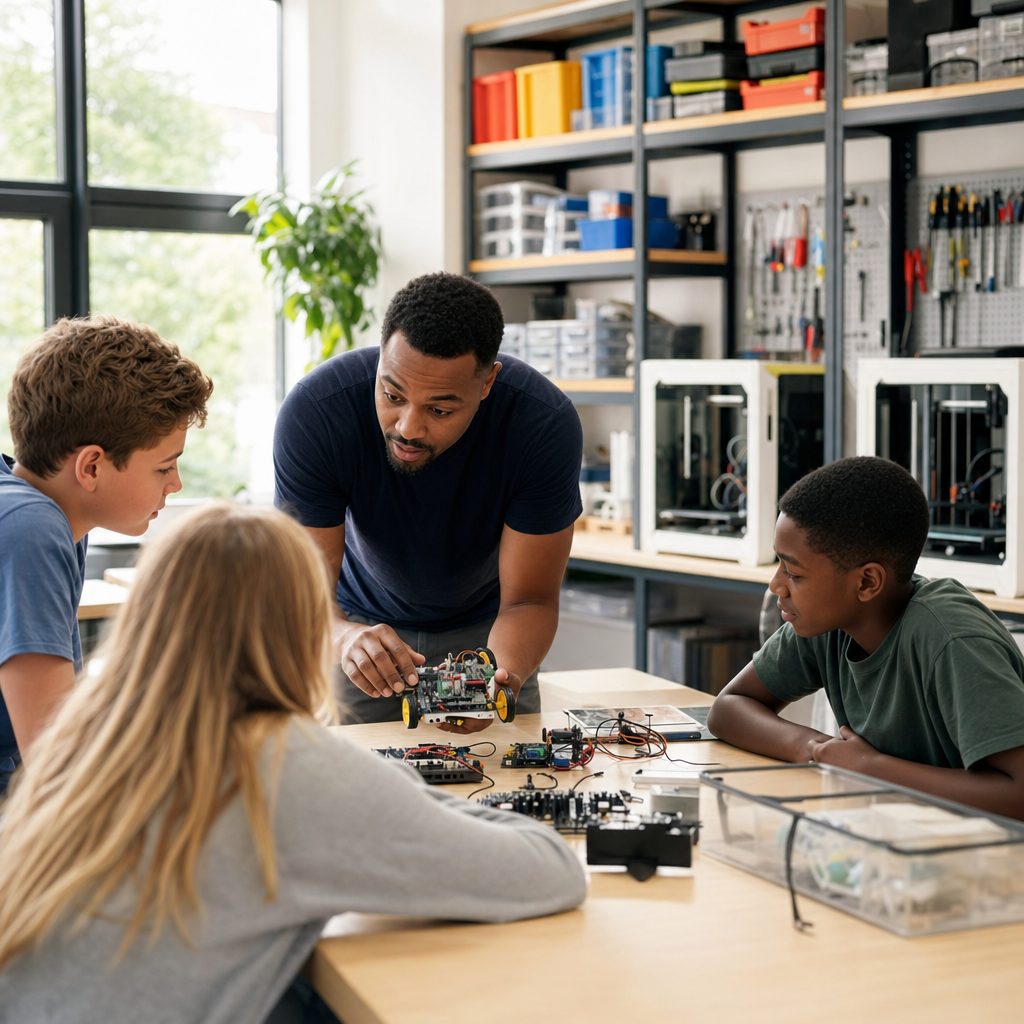
A STEM and robotics learning center puts soldering irons, 3D printers, power tools, and live electronics into the hands of students every session. That hands-on activity drives a risk profile most school policies were never written for: participant injury, defective-build product liability, and equipment loss. We help you build a program designed around how your makerspace actually operates.
Carriers We Represent
Why STEM & Robotics Learning Centers Need Specialized Insurance
The defining exposure at a STEM and robotics center is hands-on equipment injury. Students operate soldering irons, 3D printers, laser cutters, power tools, and the moving mechanical and electrical builds they assemble themselves. University and institutional safety programs document that the most common makerspace injuries are burns from hot 3D-printer components and hot resin, plus lacerations and pinch injuries from hand and power tools (see Harvard Environmental Health and Safety). Because the activity itself is the hazard, a generic school or office liability policy is the wrong starting point.
There are two liability spines a STEM center must close. First, participant injury general liability covers a student hurt while soldering, printing, or running a robot on premises. Second, and far less understood, is products liability: when a center sells, distributes, ships, or sends home a kit, a competition robot, or a student-built device that later malfunctions and injures someone, that is a defective-product claim, not a slip-and-fall. The CPSC has flagged emerging hazards specific to this equipment, including ultrafine particles and volatile organic compounds emitted during 3D printing (U.S. Consumer Product Safety Commission).
We build STEM and robotics learning centers their own commercial insurance programs that pair participant-injury GL with products-completed-operations liability, abuse and molestation coverage where minors enroll, educators professional liability, and property coverage scaled to a six-figure equipment lab.
- Burns from soldering irons, hot-end nozzles, and 3D-printer resin during supervised builds
- Lacerations, punctures, and pinch injuries from power tools, hand tools, and moving robot assemblies
- Products and completed-operations claims when a take-home kit, sold device, or competition robot malfunctions
- Electrical shock and fire risk from student-wired circuits, batteries, and soldering stations
- Inhalation and chemistry exposure from 3D-printer emissions, adhesives, and maker chemicals
- Abuse and molestation exposure wherever minors enroll, frequently excluded or sublimited in base GL
- Equipment damage and theft across printers, robotics kits, laptops, and lab tooling
Core Coverages for STEM & Robotics Learning Centers
The lead coverage is general liability written to include participant injury, so a student burned at a soldering station or cut by a power tool is actually covered rather than excluded as an athletic-style participation hazard. Layered directly on top is products and completed-operations liability for any kit, robot, or device your center sells, ships home, or hands off, because a defective build that injures a third party is a product claim the way a defective component is for any manufacturer or distributor.
Because most STEM centers enroll minors, abuse and molestation (A&M) coverage is essential. A&M is in a hard market and is frequently excluded from base general liability or sublimited as low as $25,000, so we secure adequate standalone or endorsed limits. Educators professional liability (E&O) responds to claims of negligent instruction or a failed promised outcome, such as a guaranteed competition placement or certification. Commercial property and inland marine cover your printers, laser cutters, robotics inventory, laptops, and lab tooling, and workers' compensation covers your instructors. Rounding out the stack: business owners policy structure, EPLI, cyber and student-data coverage, and a commercial umbrella. This is the kind of program we assemble as part of a broader commercial insurance build.
Where your center sits alongside another trade, such as a coding-heavy curriculum, we scope you as the school and keep the focus on students in training rather than a software operating business.
- General liability with participant-injury coverage for hands-on equipment use
- Products and completed-operations liability for kits, sold devices, and competition robots
- Abuse and molestation (A&M) coverage with adequate limits wherever minors enroll
- Educators professional liability (E&O) for instruction, certification, and outcome claims
- Commercial property and inland marine for printers, tools, robotics kits, and computers
- Workers' compensation for instructors, lab techs, and program staff
- Cyber and student-data (FERPA) coverage plus EPLI and a commercial umbrella
Licensing, Compliance & Regulatory Considerations for STEM & Robotics Learning Centers
STEM and robotics learning centers occupy a lighter-touch regulatory lane than daycares or career colleges. Most operate as enrichment or out-of-school-time programs that are not childcare-licensed: many states exempt programs that serve school-age children outside regular school hours and exist to promote expanded learning and enrichment, with oversight running through the state Department of Education rather than a childcare licensing agency (Childcare.gov). If you operate as a franchise, your franchise agreement will typically dictate minimum insurance limits, additional-insured status for the franchisor, and safety standards you must carry regardless of state rules.
Even without childcare licensure, equipment safety standards govern your floor. Robots, power tools, and machinery fall under recognized machine-guarding principles, and OSHA's general machine-guarding standard requires that guards be firmly secured and that operators be protected from hazards within a machine's working envelope (Occupational Safety and Health Administration). These standards anchor your written safety protocols, instructor training, and the carrier's risk assessment.
Confirm whether your state classifies your program as enrichment-exempt or as a licensed private school, whether any franchise or affiliation agreement imposes its own insurance mandates, and whether selling take-home kits triggers product-safety obligations. We help you align coverage to whichever lane applies.
- Most STEM enrichment programs are not childcare-licensed; oversight often runs through the state Department of Education
- Out-of-school-time and enrichment exemptions vary by state and must be confirmed locally
- Franchise agreements typically dictate minimum limits, additional insureds, and safety standards
- OSHA machine-guarding principles inform robotics, power-tool, and equipment safety protocols
- Selling or shipping take-home kits can trigger product-safety and labeling obligations
- Accredited or affiliated programs may face additional documentation and annual filings
- Background-check and supervision requirements apply wherever minors are enrolled
Why STEM & Robotics Learning Centers Choose The Allen Thomas Group
The Allen Thomas Group is an independent, family-owned insurance agency founded in 2003 and licensed in 28 states. We are not captive to a single carrier, so we place your program with the right market from our roster of 15-plus A-rated carriers and advocate for your center rather than for an insurer.
We carry an A+ rating with the Better Business Bureau, and our approach is advisory rather than transactional. We take the time to understand how your makerspace actually runs, which equipment students touch, what you sell or send home, and how minors are supervised, then we match those facts to education and specialty carriers who understand hands-on learning exposures.
Every client gets annual coverage reviews so your limits keep pace as you add printers, launch competition teams, open new locations, or expand your product line. When a claim happens, you have a dedicated advocate in your corner.
- Independent, family-owned agency founded in 2003, licensed in 28 states
- Access to 15-plus A-rated carriers, including education and specialty markets
- A+ rating with the Better Business Bureau
- Advisory, consultative approach built around your specific makerspace operations
- Specialists in participant-injury, products, and A&M exposures for hands-on programs
- Annual coverage reviews that scale with new equipment, teams, and locations
- Dedicated claims advocacy when an incident occurs
How Much Does STEM & Robotics Learning Center Insurance Cost?
Premiums are driven by the things that actually move risk: total enrollment and the share of students who are minors, the number of instructors and your annual payroll, the specific equipment students operate, the replacement value of your lab, whether you sell or ship products, and your claims and abuse history. A small after-school robotics club running a handful of laptops and entry-level kits sits at the low end; a multi-room makerspace with laser cutters, a printer farm, power-tool stations, and a product line sits much higher.
As a working benchmark, a small STEM learning center can often secure a business owners policy bundling general liability and property in the range of roughly $1,200 to $3,000 per year. Adding meaningful abuse and molestation limits, products and completed-operations coverage, and educators E&O commonly brings a typical center's total program into the $3,500 to $9,000+ range annually, depending on enrollment, equipment values, and product sales. Workers' compensation is priced separately on payroll, and a commercial umbrella adds a few hundred dollars per million of additional limit.
Because every center's mix of equipment, minors, and product sales is different, the only accurate number comes from a tailored review. We compare 15-plus carriers to find the right structure at the right price.
- Total enrollment and the proportion of enrolled minors
- Number of instructors and total annual payroll (drives workers' comp)
- Equipment mix and lab replacement value: printers, laser cutters, power tools, kits, computers
- Whether the center sells, ships, or sends home kits and devices (products exposure)
- Abuse and molestation limits required and prior abuse or injury claims history
- On-site activities, field trips, and any competition travel
- Building, location count, and property values insured
STEM & Robotics Learning Center Risk Management & Coverage Considerations
Strong risk management lowers both incidents and premiums. On the A&M side, run criminal background checks on every instructor and volunteer, enforce a two-adult rule so no staff member is ever alone with a child, and keep sightlines open across the lab. On the participant-injury side, require signed waivers and participation agreements, post equipment-specific safety rules, mandate eye protection and proper ventilation at soldering and printing stations, and verify machine guarding on every tool.
Credential and train your instructors on each piece of equipment, document that training, and maintain supervision ratios appropriate to the tool being used, tighter for power tools and lasers than for laptops. Keep written emergency and first-aid plans for burns, cuts, electrical incidents, and fire, and inspect tools and printers on a schedule. If you sell or ship kits and devices, maintain product documentation, age-appropriate warnings, and a recall protocol, because that is where your products liability lives.
Protect student data under FERPA-aligned practices, secure your enrollment and payment systems against cyber risk, and review coverage annually as you add competition teams, new printers, or additional rooms. Emerging exposures worth watching include lithium-battery fire risk, 3D-printer emissions, and high-power laser cutters.
- Background checks, two-adult rules, and open sightlines to manage abuse exposure
- Signed waivers and participation agreements for all hands-on equipment activity
- Mandatory PPE, ventilation, and posted safety rules at soldering and printing stations
- Documented instructor credentialing and tool-specific training records
- Supervision ratios scaled to the hazard, tightest for power tools and lasers
- Product documentation, age-appropriate warnings, and a recall protocol for kits sold or shipped
- FERPA-aligned data practices, cyber security, and scheduled equipment inspections
Frequently Asked Questions
Does general liability cover a student injured while soldering or using a 3D printer?
Only if your general liability policy is written to include participant injury. Many base policies treat the hands-on activity itself as the hazard and can limit or exclude it, so we make sure participant-injury coverage is explicitly built in for soldering, printing, power-tool, and robotics activities.
Does general liability cover abuse or molestation claims at our center?
Usually not adequately. Abuse and molestation coverage is frequently excluded from base general liability or sublimited as low as $25,000. Wherever minors enroll, we secure standalone or endorsed A&M coverage with limits that reflect the real exposure.
We sell or send home robotics kits. Do we need products liability?
Yes. When a kit, sold device, or competition robot you provided later malfunctions and injures someone or damages property, that is a products and completed-operations claim, not a premises claim. STEM centers that sell, ship, or send home products need products liability layered onto their general liability.
What is the difference between general liability and professional liability for a STEM center?
General liability responds to bodily injury and property damage, such as a burn or a fall on your premises. Educators professional liability (E&O) responds to the instruction itself, such as claims of negligent teaching or a failed promised outcome like a guaranteed competition placement. Most centers need both.
Do we need workers' compensation for our instructors?
In nearly every state, yes, once you have employees. Workers' compensation covers instructors and lab staff for work-related injuries such as burns or cuts and is required in most states regardless of whether the program is childcare-licensed. It is priced separately on payroll.
Are STEM and robotics learning centers required to be childcare licensed?
Typically not. Most operate as enrichment or out-of-school-time programs that many states exempt from childcare licensing, with oversight running through the state Department of Education or a franchise agreement instead. Requirements vary by state, so confirm your local classification before assuming you are exempt.
Are field trips and competition travel covered?
Off-site activities and travel to competitions can change your exposure, including hired-and-non-owned auto if staff drive students or supplies. We review your transportation arrangements and add the right auto and off-premises coverage so trips and tournaments are not a gap.
What drives the cost of STEM learning center insurance the most?
Enrollment and the share of minors, instructor payroll, the equipment students operate, the replacement value of your lab, whether you sell or ship products, and your claims and abuse history. Centers with laser cutters, printer farms, and a product line cost more than a small after-school club.
Protect Your STEM & Robotics Learning Center the Right Way
Let The Allen Thomas Group build a program around how your makerspace actually operates, from participant-injury and products liability to A&M and equipment coverage. Call (440) 826-3676 and we will compare 15-plus A-rated carriers to find the right fit for your center.