
Geothermal Installer Insurance
Geothermal heat pump installation isn’t ordinary HVAC work. Boring ground-loop wells 100 to 400+ feet into the earth brings underground utility strikes, groundwater and aquifer liability, and well-code compliance into your risk picture in a way a standard HVAC contractor never faces. The Allen Thomas Group builds geothermal installer programs around the ground-loop drilling, completed-operations, and environmental exposures generic contractor policies quietly leave out.
Carriers We Represent
Why Geothermal Installers Need Specialized Insurance
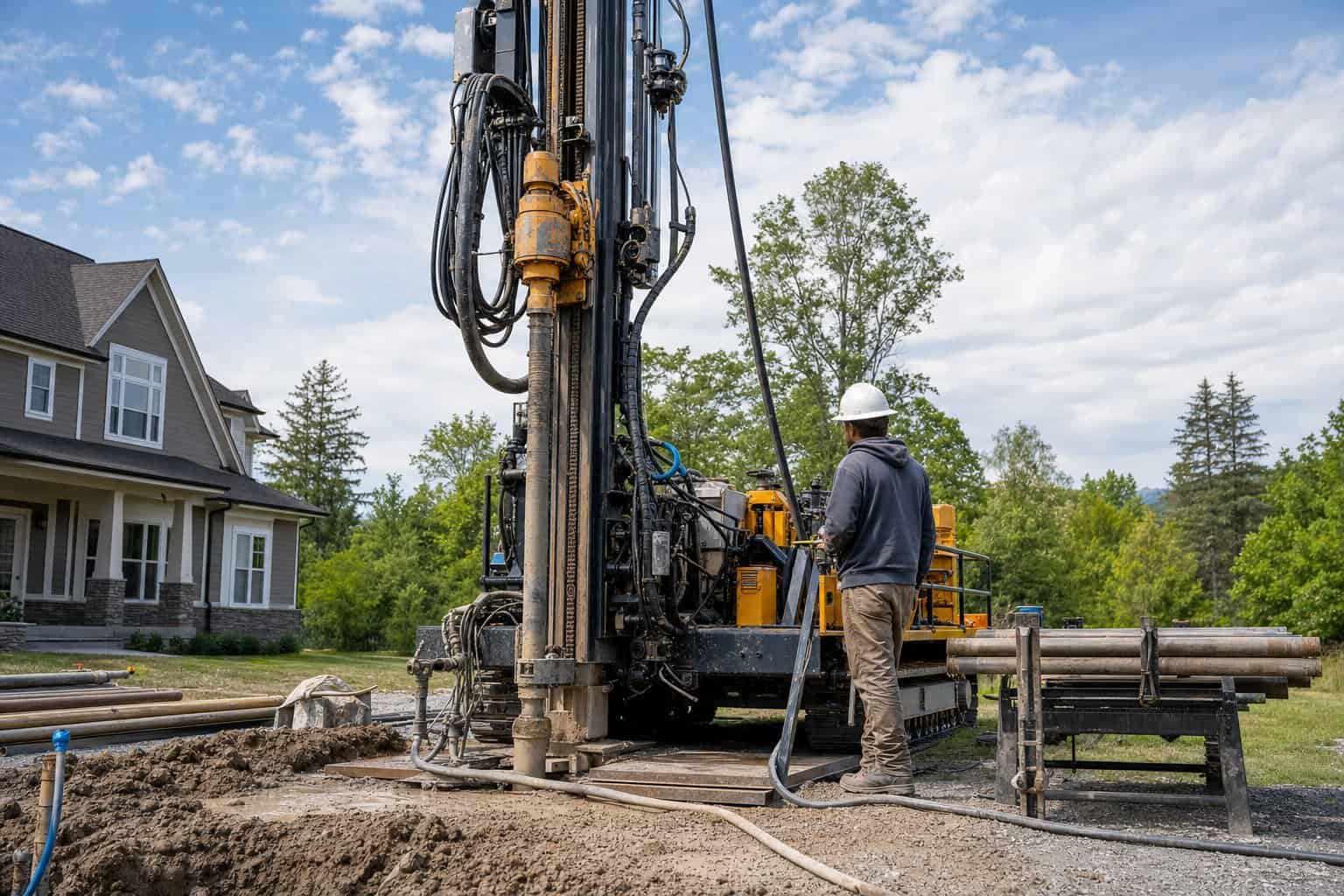
A geothermal installer does two jobs a standard HVAC contractor never touches: boring vertical wells deep into the earth, then connecting that ground loop to a heat pump system inside the building. That drilling phase is what separates your risk profile from a furnace-and-ductwork shop. Vertical boreholes commonly run 100 to 400 feet or more, and every one of them is drilled blind into ground that may hold gas lines, water mains, electrical conduit, sewer lines, or a neighboring property’s own well. A locate that is skipped or misread turns into a struck utility, and depending on what you hit, that can mean anything from a service outage to a serious injury.
The law backs this up: every state requires contacting the free 811 utility-locating service before excavation or drilling begins, precisely because unmarked-utility strikes are the leading cause of dig-related damage nationwide, according to the 811 Before You Dig national service. Your general liability program has to be built with drilling and boring operations disclosed and rated correctly, not written as if you were a duct-and-register shop, or a strike claim can run into a coverage dispute at the worst possible time.
Completed-operations risk is the other half of the picture. A geothermal system that underperforms, whether from an undersized loop field, poor grouting, or a design that didn’t match the site’s actual ground conditions, can generate a warranty dispute or a professional-liability claim months or years after your crew leaves the site. We help geothermal installers build commercial insurance programs around both the drilling exposure and the long-tail performance risk, not just the finished mechanical install.
- Vertical boreholes of 100 to 400+ feet carry real underground utility strike risk on every job
- 811 utility locating is a legal requirement before any ground-loop drilling begins, every state, every dig
- Struck gas, electrical, water, or sewer lines can mean property damage, service outages, or serious injury claims
- Aquifer cross-contamination from a poorly sealed borehole is a distinct environmental liability exposure
- Underperforming loop fields or poor heat transfer can trigger completed-operations and warranty claims later
- Drilling rigs, mud pumps, and grouting equipment are high-value mobile equipment exposed to theft and jobsite damage
- Subcontracted drilling crews working under your contract can pull liability back to you without the right agreements
Core Coverages for Geothermal Installers
A geothermal installer’s program starts with general liability sized and rated for drilling and boring operations, not generic HVAC installation, because an underwriter who doesn’t know you bore wells will not price or defend that exposure correctly. Completed operations coverage within that GL policy is what responds months or years after the job when a loop field underperforms or a connection fails, which matters in a trade where system performance problems surface well after final walkthrough. Pollution liability, sometimes called contractors pollution liability or environmental impairment coverage, fills the gap that standard GL excludes: groundwater or aquifer contamination from a compromised borehole or grout seal is a pollution event, not an ordinary property-damage claim, and it needs its own coverage grant.
From there the program covers the equipment and people doing the work. Inland marine or equipment coverage protects drilling rigs, mud pumps, grouting equipment, and the trenchers and directional bore machines that represent a serious capital investment sitting on jobsites and trailers. Workers’ compensation is mandatory for employees in most states and rated for the heavy-equipment, confined-space, and manual-handling risk drilling crews carry. Commercial auto covers trucks and trailers hauling rigs between sites, and if you subcontract vertical drilling to a specialty well driller while you handle the mechanical connection, both parties need liability coverage and certificates of insurance naming each other, so a claim doesn’t fall entirely on the general contractor of record.
- General liability rated specifically for drilling, boring, and ground-loop installation operations
- Completed operations coverage for loop-field performance and connection failures discovered after the job
- Contractors pollution liability for groundwater or aquifer contamination from a compromised borehole
- Inland marine / equipment coverage for drilling rigs, mud pumps, grouting rigs, and directional bore equipment
- Workers’ compensation rated for drilling-crew confined-space, heavy-equipment, and manual-handling exposure
- Commercial auto for trucks and trailers transporting rigs and materials between jobsites
- Subcontractor liability and certificate tracking when drilling is performed by a specialty well driller
Licensing, Compliance & Regulatory Considerations for Geothermal Installers
Geothermal work sits at the intersection of two regulatory worlds, and installers who only hold an HVAC license are often missing half the picture. The mechanical connection, running the loop to the heat pump, falls under standard HVAC or mechanical contractor licensing in virtually every state. The vertical bore itself is a different animal: many states require a separate, dedicated well driller’s license to operate a drilling rig and set casing, and that license is what governs how the annular space around the pipe must be sealed. Grouting standards exist for a real reason, an improperly sealed borehole can let water move between aquifer zones that were never meant to connect, and state well codes specify the grout material, seal depth, and abandonment procedure precisely to prevent that. Texas, for example, requires the annular space of a closed-loop geothermal well to be backfilled to total depth with bentonite or an equivalent impervious material.
State programs vary meaningfully in how closely they regulate closed-loop systems, so don’t assume your neighboring state’s rules apply to you. New York’s environmental conservation law, administered by the NYS Department of Environmental Conservation Water Well Contractor Program, requires driller registration and reporting for open-loop and standing-column geothermal wells but not for closed-loop systems, while other states require registration and reporting across the board. Confirm your specific state’s well-code and closed-loop requirements before you bid a job, not after.
Training matters just as much as licensing on the mechanical side. Programs and continuing-education credentials administered through the International Ground Source Heat Pump Association at igshpa.org are the industry’s recognized benchmark for loop design, pipe fusion, and installation quality, and carriers underwriting geothermal risk increasingly look for that training on file. Federal OSHA standards for excavation, trenching, and heavy-equipment operation apply directly to your drilling sites and should be built into a documented safety program, not treated as paperwork.
- Mechanical/HVAC licensing covers the loop-to-heat-pump connection in virtually every state
- Vertical boring frequently requires a separate, dedicated well driller’s license distinct from HVAC licensing
- State well codes specify grout material, annular seal depth, and abandonment procedure for boreholes
- Closed-loop vs. open-loop and standing-column systems are regulated differently state to state; verify locally
- IGSHPA-administered training and continuing education is the recognized benchmark for loop design and installation quality
- OSHA excavation, trenching, and heavy-equipment standards apply directly to drilling jobsites
- 811 utility-locate documentation should be kept on file for every bore as part of your compliance record
Why Geothermal Installers Choose The Allen Thomas Group
The Allen Thomas Group is an independent, family-owned insurance agency founded in 2003 and licensed in 28 states. Because we are independent, we are not tied to a single carrier; we compare programs across 15+ A-rated insurers and place your coverage with the one that actually understands drilling, boring, and completed-operations exposure in the geothermal trade. That independence matters here, where a generic HVAC or general contractor policy often omits pollution liability and rates the drilling portion of your operation incorrectly, or not at all.
We act as your advocate, not an order-taker. We take time to understand whether you self-perform vertical drilling, subcontract it to a specialty well driller, or focus solely on the mechanical connection, then build the program around your actual operation. We review your coverage annually as you take on larger commercial loop fields, add rigs, or expand into new states with different well-code requirements, and we hold an A+ rating with the Better Business Bureau. Our consultative, advisory approach means you understand exactly what you are buying and why.
- Independent, family-owned agency founded in 2003, licensed across 28 states
- Access to 15+ A-rated carriers, compared side by side for your specific drilling and mechanical operation
- Deep familiarity with drilling GL rating, completed operations, and pollution liability for geothermal risk
- A+ rating with the Better Business Bureau
- True advocacy: we represent you, not a single insurer
- Annual coverage reviews as you add rigs, crews, or expand into new state well-code jurisdictions
- Consultative, advisory guidance so you understand every coverage decision
How Much Does Geothermal Installer Insurance Cost?
Geothermal installer premiums run meaningfully higher than a standard HVAC contractor’s because drilling, boring, and heavy mobile equipment are rated exposures, not incidental ones. A general liability and completed operations program for a small-to-midsize installer that self-performs drilling commonly runs from roughly $3,000 to $10,000 or more per year, driven by annual revenue, whether you drill in-house or subcontract it out, your loop-field size and depth, and your claims history. An installer who subcontracts all drilling to a licensed well driller and only performs the mechanical connection typically sees a lower general liability rate, though completed-operations exposure on the finished system remains regardless of who bored the hole.
Pollution liability is the line item that changes the conversation for drillers. Because groundwater and aquifer contamination claims can be expensive to investigate and remediate even when no contamination is ultimately confirmed, contractors pollution liability is frequently underpriced or omitted by installers who don’t realize they need it until a claim arrives. Equipment coverage for rigs, mud pumps, and grouting equipment, workers’ compensation rated for your drilling-crew payroll class, and commercial auto for hauling rigs between sites all add to the total. The honest answer is that pricing is highly operation-specific, in-house drilling versus subcontracted, residential versus commercial loop fields, single-rig versus multi-crew, which is why we quote across multiple carriers rather than guessing.
- Self-performed drilling GL plus completed operations often runs roughly $3,000 to $10,000+ per year
- Annual revenue, loop-field size and depth, and whether drilling is in-house or subcontracted drive base pricing
- Pollution liability is commonly under-purchased relative to actual groundwater contamination exposure
- Prior claims history, including any utility strikes or completed-operations disputes, raises premium
- Workers’ compensation is rated on drilling-crew payroll and heavy-equipment risk classification
- Equipment coverage for rigs, mud pumps, and grouting equipment adds meaningfully to total program cost
- Subcontracting vertical drilling to a licensed well driller can lower your GL rate but not eliminate completed-ops exposure
Geothermal Installer Risk Management & Coverage Considerations
The cheapest claim is the one that never happens, and in this trade that starts before the rig ever touches ground. Call 811 on every single job, no exceptions, and keep the locate ticket and marked-utility documentation on file as part of your permanent job record. Confirm your site’s actual soil and groundwater conditions before you finalize a loop-field design, since a design mismatch is one of the most common roots of a completed-operations claim down the road.
Grouting discipline is your best defense against an environmental claim. Follow your state’s well code exactly on grout material and seal depth, document every bore’s grouting with photos and material records, and never treat sealing as the step to rush at the end of a long drilling day. If you subcontract vertical drilling, require a certificate of insurance naming you as additional insured and confirm the driller carries their own pollution liability, because a contamination claim can reach back to the general contractor of record regardless of who actually bored the hole.
Finally, invest in training and maintain it. Keep IGSHPA or equivalent training current for your design and installation staff, maintain OSHA-compliant excavation and confined-space protocols on every drilling site, and reassess your coverage every time you add a rig, take on larger commercial loop fields, or start working in a new state with different well-code requirements.
- Call 811 before every bore, without exception, and retain the locate ticket in your permanent job file
- Verify soil and groundwater conditions before finalizing loop-field design to avoid completed-operations disputes
- Follow your state well code exactly on grout material and seal depth; photo-document every bore
- Require certificates of insurance and proof of pollution liability from any subcontracted well driller
- Keep IGSHPA or equivalent installer training current across your design and field crews
- Maintain OSHA-compliant excavation, trenching, and confined-space protocols on every drilling site
- Reassess coverage whenever you add rigs, crews, larger loop fields, or expand into new state jurisdictions
Frequently Asked Questions
Does my general liability policy already cover drilling and boring, or do I need something extra?
Not automatically. A general liability policy underwritten as a standard HVAC or mechanical contractor may not properly rate or even disclose drilling and boring operations. Vertical ground-loop drilling needs to be specifically disclosed to your carrier and rated as a drilling exposure, or a utility-strike or borehole-related claim can run into a coverage dispute over whether the operation was properly underwritten in the first place.
What happens if my crew strikes a gas line or water main while drilling a geothermal loop?
A struck utility during drilling is a general liability claim for third-party property damage, and depending on what’s hit, potential bodily injury. Calling 811 before every job and keeping the locate ticket on file is both a legal requirement and your best evidence that you took reasonable care, which matters directly to how a claim gets defended.
Do I need pollution liability coverage as a geothermal installer?
In most cases, yes. Standard general liability policies typically exclude pollution events, and an improperly sealed borehole that allows water to migrate between aquifer zones is a pollution claim, not an ordinary property-damage claim. Contractors pollution liability is built specifically to respond to groundwater and environmental contamination allegations tied to drilling.
Do I need a separate well driller’s license to install geothermal ground loops?
Often, yes. Many states require a dedicated well driller’s license to operate a drilling rig and set casing for a vertical bore, separate from the HVAC or mechanical contractor license that covers connecting the loop to the heat pump. Requirements and whether closed-loop systems are exempt vary by state, so confirm your specific state’s rules before bidding a job.
What is completed operations coverage and why does it matter for geothermal systems?
Completed operations coverage responds to claims that arise after your work is finished, which matters in geothermal because an undersized loop field or poor heat transfer can take months or a full heating season to reveal itself as a performance problem. Without completed operations coverage built into your general liability policy, a warranty or performance dispute discovered after the job is done may not be covered.
I subcontract vertical drilling to a specialty well driller. Am I still exposed?
Yes. As the contractor of record on the job, a utility strike or contamination claim can reach back to you even if a subcontractor did the actual boring. Require a certificate of insurance naming you as additional insured, confirm the driller carries their own pollution liability, and keep your own coverage in place regardless of who performs the drilling.
Do I need workers’ compensation for a drilling crew?
Yes, in most states workers’ compensation is mandatory once you have employees, and it is rated specifically for the confined-space, heavy-equipment, and manual-handling risk a drilling crew carries. Rig operation, casing work, and grouting are physically demanding tasks with real injury exposure that a generic office-and-shop rating won’t reflect accurately.
What drives the cost of geothermal installer insurance the most?
The biggest cost drivers are whether you self-perform or subcontract vertical drilling, your annual revenue, the size and depth of the loop fields you install, your claims history including any utility strikes or completed-operations disputes, and whether you carry adequate pollution liability. Equipment coverage for rigs and grouting equipment, plus workers’ compensation for a drilling crew, add meaningfully to total program cost.
Protect Your Drilling Operation and Your Completed Work
From ground-loop boring to the mechanical connection, we build geothermal installer programs around the drilling, completed operations, and pollution liability coverage generic HVAC policies miss. Call (440) 826-3676 and we’ll compare 15+ A-rated carriers to match your operation.