
Crane and Rigging Insurance: Coverage Built for the Risk of the Lift
The Allen Thomas Group is an independent, family-owned insurance agency, licensed since 2003, that builds crane and rigging insurance programs around the real hazards of the trade: property in your care during a lift, damage to the item being lifted, and the catastrophic loss potential of a dropped load or tip-over. We shop your coverage, general liability, riggers liability, on-hook coverage, inland marine equipment coverage, and excess liability, across 15+ A-rated carriers and specialized crane program underwriters, licensed in 28 states.
Carriers We Work With
Last Updated: September 29, 2026
What Is Crane and Rigging Insurance?
Crane and rigging insurance is a multi-line package of commercial policies built for companies that own, rent, operate, set up, or move cranes, and for the riggers who handle the load itself. A general liability policy covers third-party bodily injury and property damage. Riggers liability is a distinct coverage for a client's property while it is in your care, custody, or control during a lift, an exposure standard general liability excludes by name. On-hook coverage pays for damage to the item being lifted while it is suspended, and inland marine covers the crane and its attachments themselves.
The right program depends on whether the business operates mobile cranes, tower cranes, or boom trucks, whether it provides operators or dry-rents equipment, and the size of the projects it bids. Commercial and industrial lifts routinely carry $5 million or more in liability exposure per job, well beyond what a generic contractor policy is built to absorb.
Why Riggers and Crane Operators Need a Specialized Insurance Program
A single lift can involve equipment and cargo worth more than most contractors' entire annual revenue, moving directly over people, vehicles, and structures. Standard contractor policies are built around fixed-location risk and everyday liability, not the specific moment a multi-ton load leaves the ground.
Client Property Is in Your Care During Every Lift
Rigging work almost always involves handling equipment or materials that belong to someone else. Riggers liability responds to damage to that property while it is in your care, custody, or control, a distinct legal exposure that general liability, written for injury and damage you cause to others, does not cover.
A Dropped or Swinging Load Is a Catastrophic Loss, Not a Minor Claim
Unlike most trades, a single failure in this business, a dropped load, a boom collapse, a tip-over, can generate a claim large enough to exceed standard policy limits in one event. This is why excess and umbrella limits of $5 million or higher are common on crane and rigging programs, not an upsell.
Certified Operators Are a Real Underwriting Factor
OSHA's crane and derrick standard, 29 CFR 1926 Subpart CC, requires operators to be certified and evaluated, and signal persons to hold their own separate qualification. Underwriters treat documented operator certification as a real factor in both eligibility and pricing, not just a compliance checkbox.
Core Insurance Coverages for This Trade
General Liability Insurance
General liability covers third-party bodily injury and property damage caused by your crane and rigging operations. For most operations, $1 million per occurrence and $2 million aggregate is the baseline, with commercial and industrial projects often requiring higher limits.
Riggers Liability
Riggers liability protects a client's property while it is specifically in your care, custody, or control during a lift, filling a gap standard general liability policies exclude by name. This is one of the defining coverages of this trade, not an optional add-on.
On-Hook Coverage
On-hook coverage pays for damage to the item being lifted while it is suspended from the crane. It addresses the exact moment of highest risk in a lift, a gap most property and cargo policies never contemplate.
Inland Marine (Equipment) Insurance
Cranes, booms, and attachments represent substantial capital investment. Inland marine coverage insures owned or rented equipment against theft or damage, whether it is in transit between job sites or actively working on one.
Commercial Auto Insurance
Commercial auto protects over-the-road transit for mobile cranes and heavy haulers moving equipment between job sites, a distinct exposure from the liability created by the lift work itself.
Excess and Umbrella Liability
Excess and umbrella coverage extends primary liability limits, frequently up to $5 million or higher, for the catastrophic losses this trade can generate in a single incident. Some crane and rigging programs also use a per-project aggregate structure so one job's claim doesn't reduce the limit available on another.
How Much Does Crane and Rigging Insurance Cost?
A small crane and rigging operation typically pays $5,000 to $9,000 per year for general liability alone, reflecting the high property values involved in a single lift. A company with employees, owned cranes, riggers liability, and on-hook coverage together can expect combined annual premiums of $35,000 to $70,000 or more, depending on equipment values, crew size, and whether excess liability of $5 million or higher is required for the projects being bid.
| Coverage | Avg Monthly Cost | Avg Annual Cost | Typical Limit |
|---|---|---|---|
| General Liability | $455 | $5,460 | $1M / $2M aggregate |
| Riggers Liability | $325 | $3,900 | $500K–$1M |
| On-Hook Coverage | $185 | $2,220 | Per-load, varies |
| Workers Compensation | $780 | $9,360 | Statutory |
| Inland Marine (Cranes & Equipment) | $650 | $7,800 | Varies with equipment value |
| Commercial Auto | $410 | $4,920 | $1M CSL |
| Excess / Umbrella | $520 | $6,240 | $5M+ |
These are industry averages, not quotes. A company operating tower cranes, taking on high-value industrial lifts, or with prior claims will pay more than the averages above, and may need placement with a specialized crane program underwriter rather than a standard commercial carrier.
Key factors that drive crane and rigging premiums higher than the averages above:
- Mobile cranes and tower cranes versus boom trucks and smaller lifting equipment
- Providing certified operators versus dry-renting equipment to another crew
- Total insured value of owned and rented cranes and attachments
- Excess liability limits required by commercial and industrial project contracts
- Prior property damage or injury claims in the last three to five years
How The Allen Thomas Group Can Help You
If you operate mobile cranes, tower cranes, or boom trucks, whether you provide operators or dry-rent equipment, The Allen Thomas Group shops your coverage across 15+ A-rated carriers and specialized crane program underwriters instead of forcing this risk into a generic contractor policy. We help you decide whether riggers liability, on-hook coverage, and a per-project aggregate structure fit your actual work.
Insurance Requirements for Crane Operators
Crane operators working in construction must be certified and evaluated under OSHA's crane and derrick standard, and signal persons used during a lift carry their own separate qualification requirement. Underwriters treat documented certification as a real underwriting factor, since an uncertified operator involved in a claim can complicate both liability and coverage.
Beyond operator certification, most commercial and industrial project owners require $5 million or more in combined liability limits, proof of active workers compensation, and a certificate of insurance naming them as an additional insured before a crane is allowed on site. Requirements vary by project owner and contract, so confirm both the specific job's insurance clause and your state's licensing rules before bidding.
Common Claims in This Trade and How Coverage Responds
Scenario 1: A Load Drops and Damages a Client's Equipment
A rigging crew is lifting a client's industrial equipment into place when a strap fails and the load drops, damaging the equipment. Because the equipment was in the rigging company's care, custody, and control during the lift, this falls to riggers liability, not general liability.
Scenario 2: A Suspended Beam Swings Into a Building Facade
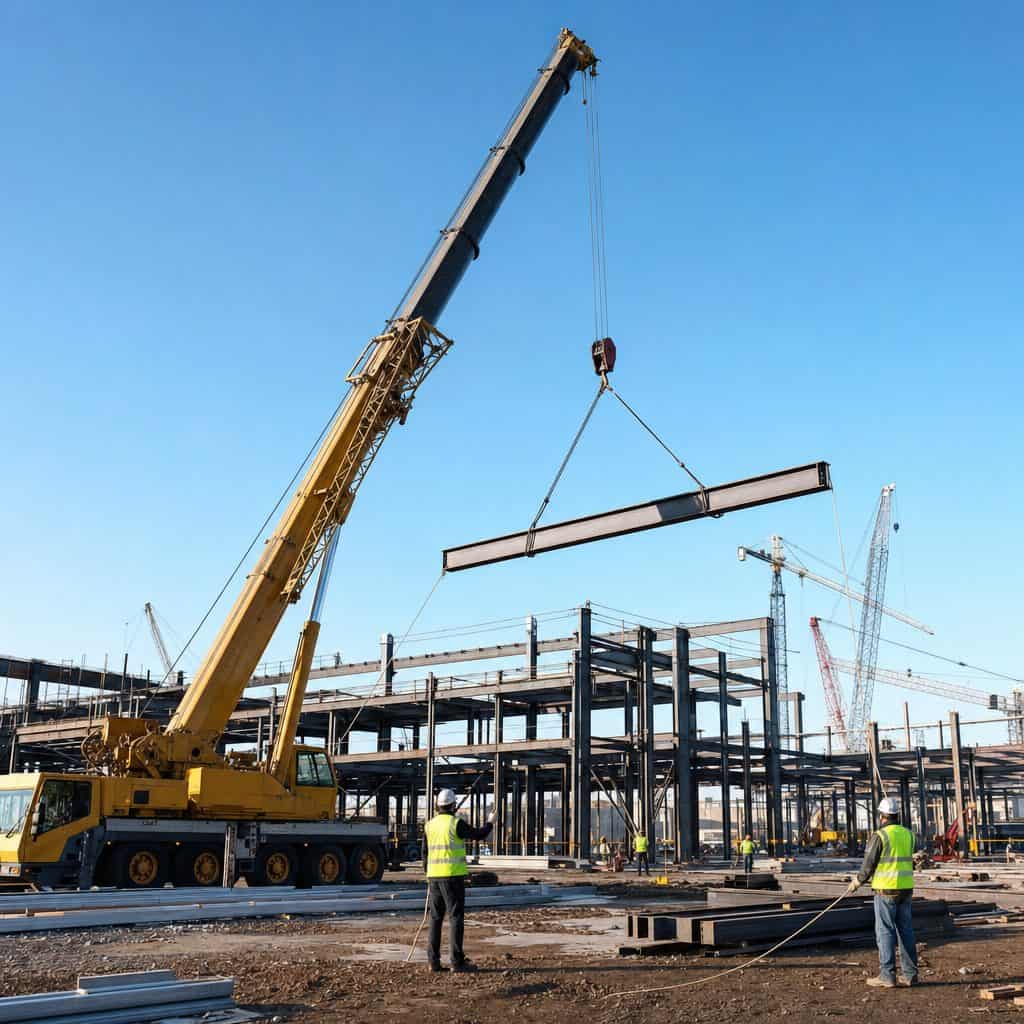
A steel beam being lifted swings unexpectedly and strikes the facade of the building under construction, causing $85,000 in damage. Because the loss occurred to the item itself while suspended, this is an on-hook coverage claim.
Scenario 3: A Rigger Is Injured During Setup
A rigger is struck by a swinging cable during crane setup, resulting in a serious injury and extended time away from work. Workers compensation covers medical costs and a portion of lost wages, and it protects the company from a direct lawsuit by the injured employee.
Scenario 4: A Mobile Crane Tips Over on Soft Ground
A mobile crane tips over due to unstable ground conditions, damaging the crane itself and a nearby vehicle, with total losses exceeding $400,000. Inland marine responds to the crane's own damage, general liability responds to the third-party vehicle, and excess liability absorbs the portion above the primary limits.
Frequently Asked Questions
What kind of insurance does a crane and rigging business need?
Most crane and rigging businesses need general liability as the foundation, plus riggers liability for property in their care, custody, or control during a lift and on-hook coverage for the item being lifted. Workers compensation covers crew injuries, inland marine covers owned or rented cranes and attachments, commercial auto covers transit and mobile cranes, and excess or umbrella liability extends limits for catastrophic losses.
What is riggers liability insurance and how is it different from general liability?
General liability covers third-party bodily injury and property damage caused by your operations broadly. Riggers liability is a distinct, narrower coverage for a client's property while it is specifically in your care, custody, or control during a lift, an exposure most standard general liability policies exclude by name. A crane company doing rigging work needs both, not one in place of the other.
What is on-hook coverage?
On-hook coverage pays for damage to the item being lifted while it is suspended from the crane, whether it drops, swings into something, or is damaged during the lift itself. It is a named, specific coverage rather than a broad property form, and most standard commercial property or cargo policies do not address this exact moment of risk.
How much does crane and rigging insurance cost?
A small crane and rigging operation typically pays $5,000 to $9,000 per year for general liability alone, given the high property values involved in a single lift. A company with employees, owned cranes, and riggers liability and on-hook coverage together can expect combined annual premiums of $35,000 to $70,000 or more, depending on equipment values, crew size, and whether excess liability of $5 million or higher is required for the projects being bid.
What are the insurance requirements for crane operators?
Crane operators working in construction must be certified and evaluated under OSHA's crane and derrick standard, and signal persons used on a lift have their own separate qualification requirement. Underwriters treat operator certification as a real factor in pricing and eligibility, not just a safety formality. Insurance requirements themselves vary by project owner and contract, with commercial and industrial projects commonly requiring $5 million or more in combined liability limits.
Do I need a specialized crane insurance program instead of a standard contractor policy?
In most cases, yes. Standard commercial contractor policies are not built for the property values and catastrophic loss potential of crane and rigging work, and many exclude riggers liability and on-hook coverage entirely unless a program built specifically for this class is used. An independent agency with access to both standard A-rated carriers and specialized crane program underwriters can place the right combination rather than forcing this risk into a generic policy.
What makes one crane and rigging insurance policy or agency the best fit for my business?
The best fit is a program that actually includes riggers liability and on-hook coverage at limits matched to your real equipment values and project sizes, not just the cheapest general liability quote. An independent agency that shops both standard carriers and specialized crane underwriters, and structures a per-project aggregate where it genuinely helps, is generally better positioned to find that fit than a single-carrier quote.
Does ATG write crane and rigging insurance in my state?
The Allen Thomas Group is licensed in 28 states and writes crane and rigging insurance programs for operations ranging from independent riggers to multi-crane fleets. Call or request a quote to confirm current availability and carrier options for your specific state.
Does workers compensation cover a rigger or crane operator injury?
Yes. Workers compensation covers medical bills and a portion of lost wages for a rigger or crane operator injured during a lift, setup, or teardown. This class carries meaningfully higher workers compensation classification rates than general contracting because of the severity potential of a dropped load or equipment failure.
What is a per-project aggregate limit and why does crane and rigging work often need one?
A per-project aggregate limit resets the liability limit for each individual job rather than sharing one limit across an entire policy term. Crane and rigging work carries genuine catastrophic loss potential, a single dropped load or structural failure can generate a claim large enough to exhaust a shared annual limit, leaving nothing for the rest of the year's projects. A per-project structure keeps each job's limit intact regardless of what happens on another job.
Get Covered for Your Next Lift
The Allen Thomas Group is an independent, family-owned broker licensed in 28 states with access to 15+ A-rated carriers and specialized crane program underwriters. One call gets you competitive rates from across the market, not a single carrier's take-it-or-leave-it quote. Certificates of insurance issued same day for active policies.