
Nevada Tree Service Insurance
The Allen Thomas Group is an independent, family-owned insurance agency, licensed since 2003, that builds tree service insurance programs for Nevada arborists and tree care contractors around a real bi-state permit system unique to the Lake Tahoe Basin. We shop your coverage, general liability, workers compensation, inland marine equipment coverage, commercial auto, and professional liability, across 15+ A-rated carriers, licensed in 28 states.
Carriers We Work With
Last Updated: September 30, 2026
What Is Tree Service Insurance in Nevada?
Nevada tree service insurance is the same core package described on our national tree service insurance page, general liability, workers compensation, commercial auto, inland marine equipment coverage, and professional liability, applied to a state whose most distinctive regulatory rule applies only in one specific region: the Lake Tahoe Basin.
The biggest state-specific difference is that Nevada's tree service market genuinely splits in two: standard desert-climate work in Las Vegas and Reno, and a specialized, permit-heavy practice in the Tahoe Basin governed by a bi-state agency most companies elsewhere never encounter.
Why Nevada Tree Care Companies Face a Different Risk Picture
Nevada's defining fact for this trade is a real, verified bi-state permit system specific to the Lake Tahoe Basin.
The Tahoe Regional Planning Agency Regulates Tree Removal
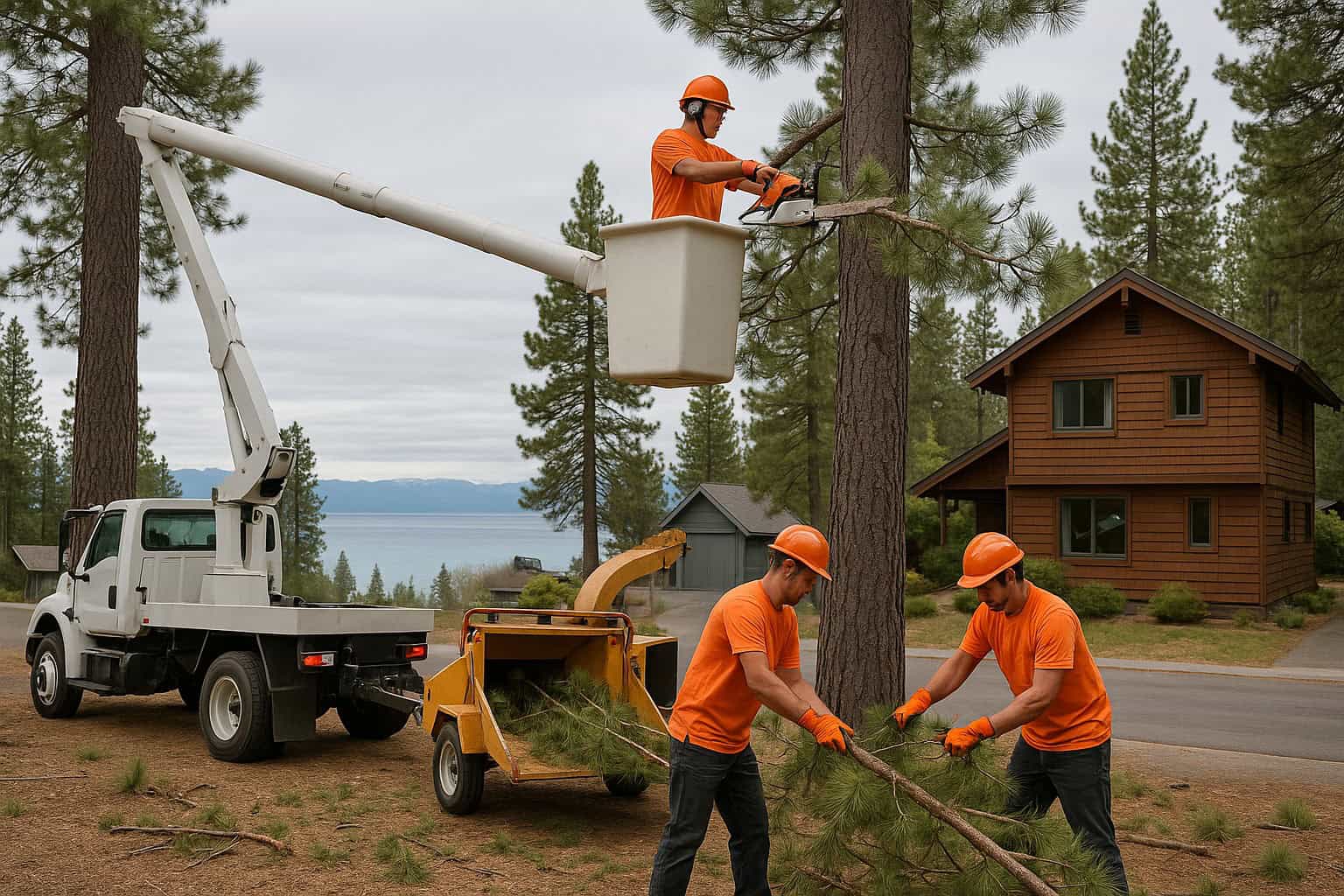
The Tahoe Regional Planning Agency, a real bi-state Nevada-California compact agency, requires a permit to remove a live tree greater than 14 inches in diameter at breast height, dropping to a 6-inch threshold for trees between a house and the lakeshore. Dead-tree removal near a structure is generally exempt without a permit, and a permit is also required for removing the upper two-thirds of a tree's branches or for vegetation work in Stream Environment Zones. Following the 2007 Angora Fire, TRPA has actively promoted tree removal for wildfire defensible space.
Nevada Privatized Its State Fund in 1999
Nevada's exclusive state fund, the State Industrial Insurance System, was privatized on July 1, 1999, becoming Employers Insurance Company of Nevada, which began operating January 1, 2000, the direct ancestor of today's Employers Holdings, Inc. This is a real, distinct privatization history from West Virginia's 2008 transition.
Tree Work Falls Under a Landscape Contracting License, Not Its Own Category
The Nevada State Contractors Board issues no standalone tree service or arborist license. Tree maintenance and removal falls under Classification C-10, Landscape Contracting, whose statutory text explicitly authorizes holders to plant and maintain trees and other vegetation, unlike California's dedicated C-49 Tree and Palm classification.
Core Insurance Coverages for Nevada Arborists
The coverage types match the national tree service program: general liability, workers compensation, commercial auto, inland marine, and professional liability, all shopped across our full carrier panel.
General Liability Insurance
General liability covers the property-damage exposure of removal work, including jobs performed under a TRPA permit in the Lake Tahoe Basin.
Workers Compensation Insurance
Required for Nevada tree service crews, shopped across our full carrier panel.
Commercial Auto Insurance
Commercial auto covers the trucks and chipper trailers your crews rely on to move between job sites across Las Vegas, Reno, and the Lake Tahoe Basin.
Inland Marine (Tools and Equipment)
Chainsaws, stump grinders, and crane attachments are covered wherever they travel across the state, whether stolen from a truck overnight or damaged on a job site.
Professional Liability (E&O)
Nevada arborists who perform paid tree health assessments or TRPA permit consulting should carry professional liability alongside general liability.
How Much Does Tree Service Insurance Cost in Nevada?
General liability pricing in Nevada falls in the same national range described on our tree service insurance page, roughly $750 to $2,300 per year for a small operation, driven by crew size, equipment, and whether Lake Tahoe Basin permit work is part of the regular business. Companies working regularly in the Tahoe Basin should expect underwriters to ask about TRPA permit compliance history, since unpermitted removal in the basin carries its own distinct regulatory exposure separate from ordinary Nevada tree work.
Key factors that drive Nevada tree service premiums:
- Volume of Lake Tahoe Basin permit work
- Whether the business holds a C-10 Landscape Contracting license
- Payroll and crew size
- Prior claims history
- Municipal or utility contract requirements for higher limits
How The Allen Thomas Group Can Help You
We shop your general liability, workers compensation, commercial auto, inland marine, and professional liability across 15+ A-rated carriers, and we help Nevada tree service companies understand how TRPA's Lake Tahoe Basin rules affect their coverage needs.
Licensing and Regulatory Notes for Nevada Tree Care Businesses
The Tahoe Regional Planning Agency requires a permit to remove a live tree greater than 14 inches in diameter at breast height in the Lake Tahoe Basin, with a stricter 6-inch threshold near the lakeshore. Outside the basin, the Nevada State Contractors Board regulates tree work under Classification C-10, Landscape Contracting, with no dedicated tree-service category. Workers compensation runs through the standard private-carrier system that succeeded Nevada's State Industrial Insurance System after its 1999 privatization.
Companies working in the Tahoe Basin should confirm a tree's diameter at breast height before quoting a removal, since that single measurement determines whether a TRPA permit is required at all. Companies operating in both the basin and the rest of the state should maintain separate compliance checklists for each, since the rules genuinely don't overlap.
Common Nevada Tree Service Claims and How Coverage Responds
Scenario 1: An Unpermitted Removal Is Cited in the Tahoe Basin
A crew removes a live tree over the TRPA diameter threshold without a permit, and the agency cites the contractor. This kind of regulatory-compliance dispute is the type of exposure professional liability is designed to help address.
Scenario 2: A Fence Is Damaged During a Las Vegas Removal
A crew removing a large tree in a Las Vegas neighborhood misjudges the drop zone and damages a neighbor's fence. This falls under the general liability policy's property damage coverage.
Scenario 3: A Climber Is Injured During a Large Removal
A climber falls and is injured while removing a large tree near Reno. Workers compensation covers medical bills and a portion of lost wages.
Scenario 4: Equipment Is Stolen from a Job Site
A stump grinder is stolen overnight from a job site trailer near Lake Tahoe. This falls under inland marine (tools and equipment) coverage.
Frequently Asked Questions
Does the Lake Tahoe Basin have its own tree removal permit rules?
Yes. The Tahoe Regional Planning Agency, a bi-state Nevada-California compact agency, requires a permit to remove a live tree greater than 14 inches in diameter at breast height, with a stricter 6-inch threshold for trees between a house and the lakeshore. Dead-tree removal near a structure is generally exempt without a permit, and a permit is also required for removing the upper two-thirds of a tree's branches, or for vegetation work in Stream Environment Zones.
Does Nevada have its own workers compensation privatization history?
Yes. Nevada's exclusive state fund, the State Industrial Insurance System, was privatized on July 1, 1999, becoming Employers Insurance Company of Nevada, which began operating January 1, 2000. That company is the direct ancestor of today's Employers Holdings, Inc., a different privatization year and mechanism than West Virginia's 2008 transition.
Does Nevada have a dedicated tree service contractor license?
No. The Nevada State Contractors Board does not issue a standalone tree service or arborist license. Tree maintenance and removal falls under Classification C-10, Landscape Contracting, whose statutory text explicitly authorizes holders to plant and maintain gardens, lawns, shrubs, vines, bushes, trees, and other vegetation. Nevada has no equivalent to California's dedicated C-49 Tree and Palm classification.
What insurance does a tree service business need in Nevada?
Most Nevada tree service businesses need general liability as the foundation, workers compensation, inland marine for chainsaws and stump grinders, commercial auto for trucks and chipper trailers, and professional liability if they perform paid tree health assessments or TRPA permit consulting.
How much does tree service insurance cost in Nevada?
General liability for a small Nevada tree service operation typically falls in the same $750 to $2,300 per year range seen nationally, driven by crew size, equipment, and whether Lake Tahoe Basin permit work is part of the regular business.
Does ATG write tree service insurance throughout Nevada?
Yes. The Allen Thomas Group writes tree service insurance programs for companies across Nevada, including Las Vegas, Reno, and the Lake Tahoe Basin. Call or request a quote to get started.
Get Your Nevada Tree Service Insurance Program
The Allen Thomas Group is an independent, family-owned agency with access to 15+ A-rated carriers. One call gets you competitive rates from across the market, not a single carrier's take-it-or-leave-it quote. Certificates of insurance issued same day for active policies.