
Tree Service Insurance: Coverage Built for the Risks Tree Care Professionals Face
The Allen Thomas Group is an independent, family-owned insurance agency, licensed since 2003, that builds tree service insurance programs for arborists and tree care contractors around the real hazards of the trade: falling limbs, aerial work, chainsaws and chippers, and property damage near structures and power lines. We shop your coverage, general liability, workers compensation, commercial auto, inland marine equipment coverage, and professional liability, across 15+ A-rated carriers, licensed in 28 states.
Carriers We Work With
Last Updated: September 29, 2026
What Is Tree Service Insurance?
Tree service insurance is a package of commercial policies built for arborists and tree care contractors who work at height, around chainsaws and chippers, and near structures, fences, and power lines that create liability most standard business policies were never designed for. A general liability policy covers third-party bodily injury and property damage, the falling branch that crashes onto a customer's fence or roof. Workers compensation covers a climber or ground crew member hurt on the job. Commercial auto covers the trucks and chipper trailers used to move crews and equipment. Each is a distinct policy with its own insuring agreement, exclusions, and limits.
The right combination depends on whether the business is a solo climber, a company with employees and a crew truck, or a contractor bidding municipal or utility tree work. Commercial and municipal contracts typically require higher limits and additional insured status well beyond what any state licensing rule demands.
Why Arborists Need Specialized Coverage
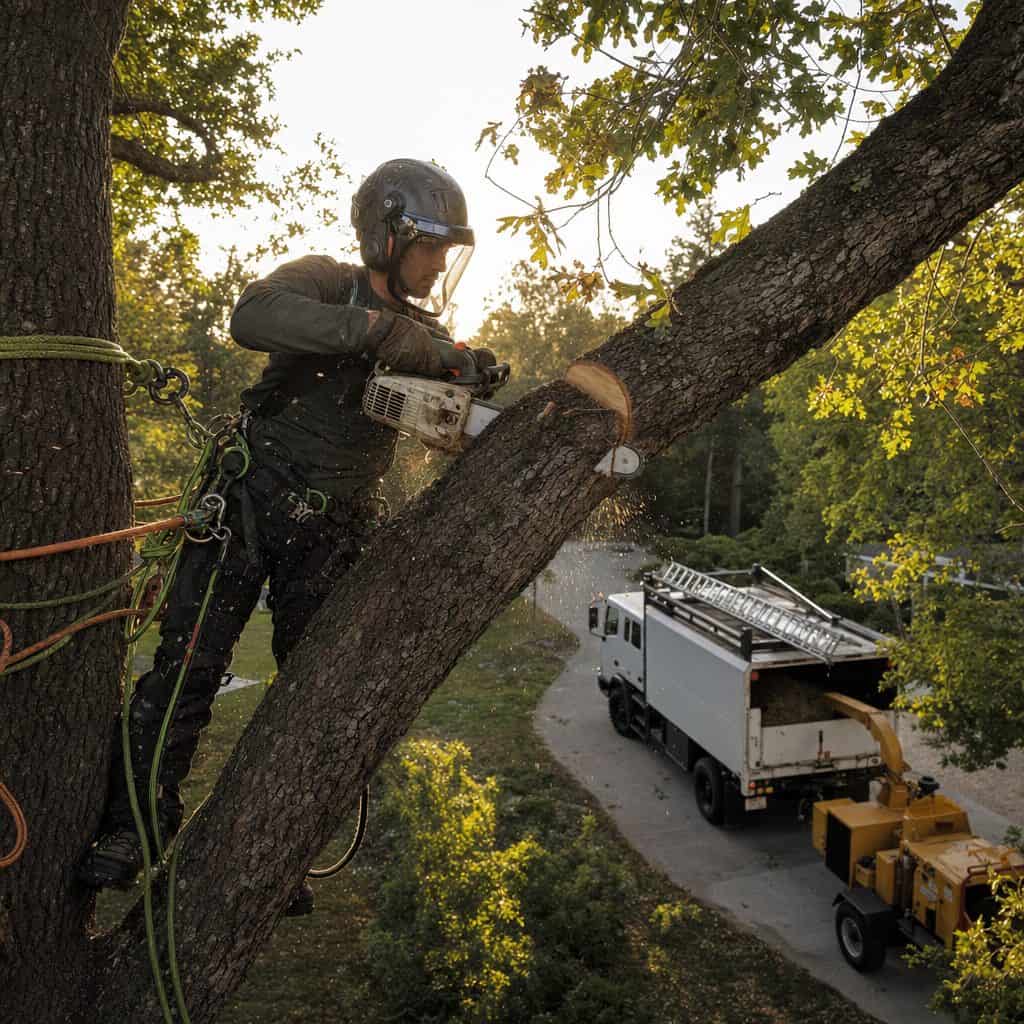
Standard business policies are built for operations that work from a fixed location on their own property. Tree work happens on someone else's property, at height, with power equipment capable of cutting through a limb the size of a person's leg in seconds. OSHA's Tree Care Industry safety guidance identifies falls, falling objects, and electrical contact as the three leading hazards in this trade.
Aerial and Climbing Work Creates Liability Standard Policies Don't Address
A tree crew removing a large limb over a driveway or a roofline is one misjudged cut away from a multi-thousand-dollar property claim, or a fall injury to the climber. Whether the work is done from a bucket truck, a crane, or by climbing with a saddle and rope, the exposure is the same: something heavy, moving fast, above a person, a car, or a building. The limits a tree service carries need to reflect the value of what sits below the work, not just the size of the crew doing it.
Heavy Equipment Multiplies Both Injury and Property Risk
Chainsaws, wood chippers, and stump grinders are the tools of the trade and among the more dangerous pieces of equipment used in any commercial trade. A chipper feed accident is a severe injury claim under workers compensation. A stump grinder that throws debris into a parked car or a customer's siding is a property damage claim under general liability. Crane-assisted removals add rigging and load-drop risk on top of both.
Property Damage From Removals Near Structures and Power Lines
Large removals near a house, a fence, a shed, or overhead power lines are where the highest-dollar claims in this trade originate. A misjudged lean or a limb that doesn't fall where planned can total a roof, a vehicle, or a section of fence in a single afternoon. Line-clearance tree work near energized lines is specifically regulated under OSHA 29 CFR 1910.269, which sets minimum approach distances and qualification requirements for crews working near power lines.
Core Insurance Policies Every Tree Care Business Should Carry
General Liability Insurance
General liability is the foundational coverage for any tree service business. It covers third-party bodily injury, third-party property damage, and advertising injury. For most tree care operations, $1 million per occurrence / $2 million aggregate is the baseline. Companies that do crane-assisted removals, work on commercial properties, or take on municipal and utility contracts frequently need $2 million per occurrence or higher.
Workers Compensation Insurance
Workers compensation is required in most states for any tree service business with employees. It covers medical expenses and a portion of lost wages for a climber, chipper operator, or ground crew member injured on the job, and it protects the business from lawsuits brought by an injured worker. Tree care carries some of the higher workers compensation classification rates of any commercial trade, driven directly by the combination of fall risk from climbing and aerial work and the severity potential of chainsaws and chippers. Published rate data for one representative state, Kentucky, shows tree surgery classified under a rate of roughly $4 to $11 per $100 of payroll, meaning a business with a $200,000 annual payroll could see an annual workers compensation premium in the $8,000 to $22,000 range before any experience-modification adjustment. Actual rates vary by state and by claims history, so confirm your own state's classification and experience modifier with your broker.
Commercial Auto Insurance
Any truck, dump body, or trailer titled in the business name and used to haul crews, chippers, or logs requires commercial auto coverage. Personal auto policies exclude business use, and a claim denial after a work-related accident leaves the business and the driver personally exposed. Commercial auto covers liability to third parties, physical damage to the vehicle, and medical payments for occupants.
Inland Marine (Tools and Equipment) Insurance
Standard commercial property coverage protects equipment at a fixed location. Chainsaws, stump grinders, and crane attachments carried between job sites are covered under inland marine policies instead. This coverage applies whether the equipment is stolen from a truck overnight, damaged in transit, or lost on a job site, and it is one of the lowest-cost, most frequently used line items in a tree service insurance program.
Professional Liability (Errors and Omissions)
General liability covers physical damage and injury. It does not cover a financial loss claim built entirely on professional judgment, such as a customer alleging that an incorrect tree health assessment led them to remove a tree unnecessarily, or that a bad trimming plan damaged a mature, high-value tree's long-term health and reduced their property's value. Arborists who perform paid tree health assessments, consulting work, or municipal tree inventory work should discuss professional liability coverage with their broker.
Commercial Umbrella Insurance
A commercial umbrella policy extends the limits of general liability, employer's liability, and commercial auto once the primary policy limits are exhausted. For tree service companies doing crane-assisted removals, working near power lines, or bidding municipal and utility contracts, umbrella limits of $1 million to $5 million are common, and some municipal and utility contracts require umbrella limits of $5 million or higher as a condition of award.
How Much Does Tree Service Insurance Cost?
A solo tree care operator with no employees typically pays $750 to $2,300 per year for a general liability policy, depending on crew size, location, and equipment. A tree service company with climbers and ground crew carrying general liability, workers compensation, and commercial auto together can expect combined annual premiums of $12,000 to $28,000, driven mainly by workers compensation payroll and whether crane-assisted removals are part of the regular work.
| Policy | Avg Monthly Cost | Avg Annual Cost | Typical Limit |
|---|---|---|---|
| General Liability | $128 | $1,540 | $1M / $2M aggregate |
| Business Owner’s Policy (BOP) | $178 | $2,136 | $1M / $2M aggregate |
| Workers Compensation | $650 | $7,800 | Statutory |
| Commercial Auto | $310 | $3,720 | $1M CSL |
| Inland Marine (Tools & Equipment) | $44 | $528 | Varies |
| Professional Liability (E&O) | $68 | $816 | $1M / $2M aggregate |
| Commercial Umbrella | $275 | $3,300 | $1M–$5M |
These are industry averages, not quotes. A tree service that does regular crane-assisted removals, has prior claims, or operates in a state with elevated workers compensation classification rates will pay more than the averages above.
Key factors that drive tree service premiums higher than the averages above:
- High-altitude climbing and crane-assisted removals versus ground-level pruning or stump grinding
- Payroll growth and crew size (workers compensation and employer's liability scale directly with payroll)
- Prior property damage or injury claims in the last three to five years
- Municipal, utility, or commercial contracts that require higher limits and additional insured status
- Operating in a state with elevated tree care workers compensation classification rates
How The Allen Thomas Group Can Help You
If you run a tree service company, whether you're a solo climber taking on residential trimming work or a multi-crew operation bidding municipal removal contracts, The Allen Thomas Group shops your coverage across 15+ A-rated carriers instead of presenting a single company's take-it-or-leave-it quote. We build the program around the work you actually do: ground-level pruning, crane-assisted removals, or both, and the client requirements you actually face.
Who Needs This Coverage? Solo Climbers to Municipal Contractors
Solo Operators and Independent Arborists
A solo tree care operator with no employees still faces third-party property damage and bodily injury claims from falling limbs and equipment use. General liability is the minimum. Many states do not require a sole proprietor to carry workers compensation on themselves, which leaves the individual with no wage replacement or medical coverage if injured while climbing or operating a chainsaw alone.
Tree Care Companies with Climbers and Ground Crew
Workers compensation becomes mandatory in most states once any employee is hired, and it is the single largest cost driver in a tree service insurance program because of the elevated classification rates this trade carries. A company with climbers should also carry employer's liability coverage, typically included within workers compensation, alongside general liability and commercial auto.
Commercial, Municipal, and Utility Tree Contractors
Tree companies bidding municipal right-of-way clearing, utility line clearance, or commercial property contracts face the most demanding insurance requirements in the trade. These contracts typically require $2 million per occurrence general liability, commercial auto at $1 million combined single limit, workers compensation at statutory limits, and umbrella coverage of $2 million to $5 million, plus additional insured status naming the municipality or utility on the general liability policy.
Common Tree Service Claims and How Coverage Responds
Scenario 1: Falling Limb Damages a Customer's Fence and Roof
A crew removing a large dead limb misjudges the drop zone. The limb clips a section of privacy fence and crushes a corner of the customer's roof on its way down. Repair costs run to $18,000. This falls under the general liability policy's premises and operations coverage, since the damage occurred while work was actively in progress.
Scenario 2: A Climber Is Injured Falling from a Bucket Truck
A crew member working from a bucket truck is struck by a swinging limb section and falls, resulting in a fractured leg and several weeks away from work. Workers compensation covers the medical bills and a portion of lost wages, and it protects the company from a lawsuit the injured employee might otherwise bring directly against the business.
Scenario 3: Incorrect Tree Health Assessment Leads to a Financial Loss Claim
An arborist is paid to assess a large, mature oak and recommends removal, telling the homeowner the tree is diseased and hazardous. The homeowner later has the stump examined and learns the tree was healthy, reducing their property's shade coverage and appraised value. Because this is a claim about professional judgment rather than physical damage caused during work, it falls to professional liability (errors and omissions) coverage, not general liability.
Scenario 4: A Stolen Chainsaw and a Damaged Stump Grinder
Overnight, tools are stolen from an unlocked job site trailer, including two chainsaws and a stump grinder attachment. Separately, a stump grinder is damaged in transit when it shifts and strikes the trailer wall. Both losses fall under inland marine (tools and equipment) coverage, since the property was away from the business's fixed location when the loss occurred.
What Are the Insurance and Licensing Requirements for Arborists?
Most commercial, municipal, and residential clients require proof of active general liability and workers compensation coverage, typically in the form of a certificate of insurance, before a crew is allowed to start work. Municipal and utility contracts commonly require the certificate to name the municipality or utility as an additional insured and to carry higher limits than a standard residential job.
Several states require tree service or arborist businesses to hold a specific contractor or arborist license, and some tie a bond requirement to that license. Licensing and bonding requirements are separate from insurance requirements and vary by state, so confirm both before bidding work in a new jurisdiction. Many tree care professionals also carry the ISA Certified Arborist credential from the International Society of Arboriculture, which is a professional certification rather than an insurance or licensing requirement, but is frequently referenced in municipal and utility bid specifications alongside insurance minimums.
- Contact your broker and request a certificate of insurance naming the client, municipality, or utility as an additional insured, with their full legal name and address exactly as it should appear.
- The additional insured endorsement is added to the general liability policy. This requires a policy change and is not automatic.
- The certificate is issued. At The Allen Thomas Group, certificate requests for active policies are typically fulfilled the same business day.
Why Tree Service Companies Work with The Allen Thomas Group
The Allen Thomas Group is an independent, family-owned insurance agency, not captive to any single carrier. We work with 15+ A-rated carriers, including Travelers, Liberty Mutual, Cincinnati Financial, Auto-Owners, The Hartford, AmTrust, Western Reserve Group, and Progressive Commercial. When your policy is up for renewal, we shop the market on your behalf rather than defaulting to the same carrier at whatever rate they set.
We are licensed in 28 states and write tree service insurance programs for operations ranging from solo climbers to multi-crew companies bidding municipal and utility contracts. Our process:
- Assess: We review the mix of removal and trimming work you do, the contracts you need to fulfill, and the coverage you currently carry.
- Review: We present options from multiple carriers with a clear comparison of limits, exclusions, and premiums, not a single take-it-or-leave-it quote.
- Service: Once your program is in place, we handle certificate requests, additional insured endorsements, and coverage questions throughout the policy year.
Get a precise quote for your tree service insurance program, or call (440) 826-3676 to speak with a commercial lines advisor.
Frequently Asked Questions
What kind of insurance does a tree service business need?
Most tree service businesses need general liability insurance as the foundation, plus workers compensation for any employee who climbs, operates a chainsaw, or works from a bucket truck. Commercial auto covers trucks and chipper trailers, inland marine covers chainsaws and stump grinders, and professional liability covers claims tied to a bad tree health assessment or trimming plan rather than physical damage.
What is general liability insurance for a tree service, and what does it cover?
General liability insurance covers third-party bodily injury and property damage caused by your tree work, such as a falling branch that crashes onto a customer's fence, roof, or vehicle. It also covers advertising injury and, through its completed operations component, damage that surfaces after a job is finished, such as a weakened limb that fails weeks later.
How much does tree service insurance cost per month?
A small tree service operation typically pays $65 to $190 per month for general liability alone, roughly $750 to $2,300 per year. A company with climbers and ground crew carrying general liability, workers compensation, and commercial auto together should expect combined monthly premiums in the $900 to $2,200 range, depending on crew size, payroll, and whether the work includes crane-assisted removals.
Do I need separate insurance for tree removal versus general tree trimming?
You do not need a separate policy, but the underwriting is not identical. Crane-assisted removals and large-tree takedowns carry more risk than ground-level pruning or stump grinding, and carriers price and sometimes endorse a policy differently based on the mix of removal versus trimming work a business actually performs. Tell your broker your real service mix so the policy is rated and covers your business accurately.
What are the insurance requirements for tree service contractors?
Most commercial, municipal, and residential clients require a certificate of insurance showing active general liability and workers compensation before a crew can start work, and many require the client to be named as an additional insured. Several states also require tree service or arborist businesses to hold a specific contractor or arborist license, and some require a bond as a condition of that license. Requirements vary by state and by the type of client, so confirm both the state licensing rule and the specific contract's insurance clause before bidding a job.
Can I get cheap tree service insurance, and what affects the price?
The lowest-cost tree service policies are written for ground-level trimming and pruning operations with no employees and no aerial or crane work. Price rises with crew size and payroll, with high-altitude climbing and crane-assisted removals, with a claims history, and with the state's workers compensation classification rates. The most reliable way to lower cost without cutting real coverage is shopping the same risk across multiple carriers rather than accepting one company's first quote.
Does ATG write tree service insurance in my state?
The Allen Thomas Group is licensed in 28 states and writes tree service and arborist insurance programs for operations ranging from solo climbers to multi-crew companies bidding municipal and utility contracts. Call or request a quote to confirm current availability and carrier options for your specific state.
What makes one tree service insurance policy or agency the best fit for my business?
The best fit is not always the cheapest quote. It is a policy matched to your actual work, crane-assisted removals versus ground-level pruning, your payroll and crew size, and any municipal or utility contract requirements, placed with a carrier that understands tree care risk. An independent agency that shops multiple A-rated carriers on your behalf, rather than one company's single quote, is generally better positioned to find that fit.
Does workers compensation cover injuries from climbing or chainsaw accidents?
Yes. Workers compensation covers medical bills and a portion of lost wages for an employee injured while climbing, working from a bucket truck, or operating a chainsaw, chipper, or stump grinder. Tree care is rated among the higher-cost workers compensation classifications of any commercial trade because of the combination of fall risk and power equipment, so payroll and true job classification should be reported accurately to avoid a premium audit surprise.
What is inland marine coverage and why do I need it for chainsaws and stump grinders?
Inland marine, also called tools and equipment coverage, protects chainsaws, stump grinders, and crane attachments while they are in transit or sitting on a job site, situations standard commercial property insurance does not cover because that coverage is written for a fixed business location. A stolen chainsaw or a stump grinder damaged in transit is a common, low-dollar claim that inland marine coverage is built specifically to handle.
Build Your Tree Care Insurance Program
The Allen Thomas Group is an independent, family-owned broker licensed in 28 states with access to 15+ A-rated carriers. One call gets you competitive rates from across the market, not a single carrier's take-it-or-leave-it quote. Certificates of insurance issued same day for active policies.