
Indiana Commercial Cleaning and Janitorial Business Insurance
The Allen Thomas Group is an independent, family-owned insurance agency that shops 15+ A-rated carriers to build coverage for commercial cleaning and janitorial companies across Indiana, not a single-carrier captive agent locked into one company’s rates and terms. We work with Indiana cleaning businesses of every size, from a single owner-operator to established janitorial companies running multiple crews across Indianapolis, Fort Wayne, and Evansville. Most quotes are ready within 1-3 business days. Click the button below to start your free quote, or call (440) 826-3676 to speak with a licensed agent directly.
Carriers We Represent


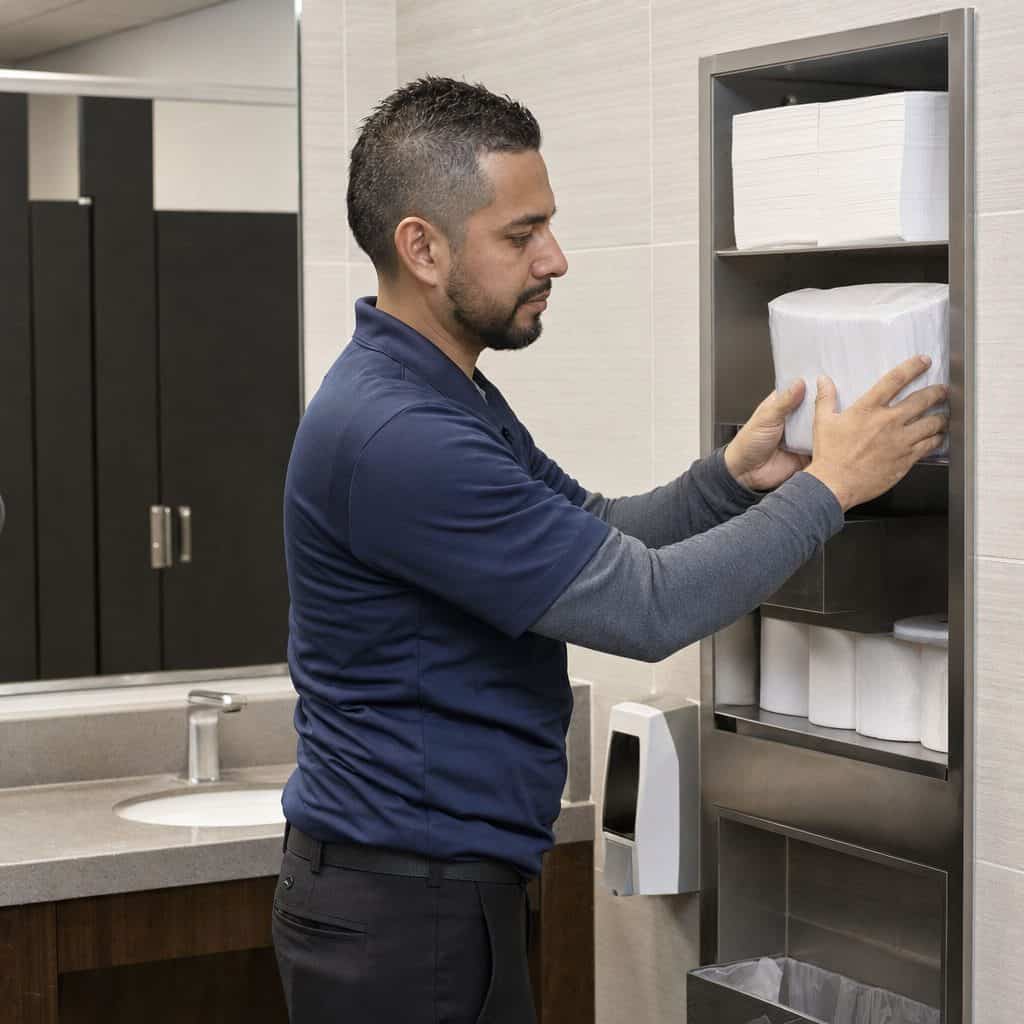
Commercial cleaning insurance in Indiana is a specialized bundle of coverage, typically general liability, a janitorial bond, and workers’ compensation, built around the specific risk of sending employees into other people’s offices and businesses across Indianapolis, Fort Wayne, and Evansville.
Why Commercial Cleaning Companies in Indiana Need Specialized Coverage
Commercial cleaning companies working Marion County (Indianapolis), Allen County (Fort Wayne), and Vanderburgh County (Evansville) service everything from downtown office towers and medical buildings to manufacturing plants and school districts. Crews on these accounts carry master keys, handle industrial-grade chemicals, and run buffers and extraction equipment inside buildings they don’t own, exposures a generic business owner’s policy typically doesn’t cover.
A cleaning crew servicing a Fort Wayne manufacturing facility could accidentally trigger a fire suppression system while buffing floors near sensitive equipment, causing significant water damage to inventory and machinery. A janitorial employee working a nighttime shift in downtown Indianapolis could slip on a wet stairwell and file a workers’ compensation claim. A subcontracted crew cleaning a medical office in Evansville could misplace a master key, forcing the building owner to rekey dozens of doors at the cleaning company’s expense.
Indiana-Specific Coverage Considerations for Commercial Cleaning Companies
Indiana does not require a separate state-level license specifically for commercial cleaning or janitorial businesses. Owners register their company as a legal entity with the Indiana Secretary of State, typically through the state’s INBiz online portal, and then handle any local permit requirements set by the city or county where they operate. Because no statewide janitorial license exists, general liability coverage and janitorial bonding often become the credentials commercial clients actually ask to see before signing a contract.
Indiana’s minimum wage has held at $7.25 an hour since 2009, matching the federal minimum, and according to the Indiana Department of Labor it applies to employers of two or more employees. Because workers’ compensation premiums for cleaning companies are built largely from total payroll, a workforce paid near this wage floor keeps base premium costs moderate, but it also means a larger hourly headcount covering more square footage per shift, which raises the volume of potential injury claims a carrier has to weigh. Companies that also employ higher-paid supervisors or specialty technicians should expect payroll audits to reflect that mix when final premium is calculated.
- Indiana workers’ compensation runs through the private insurance market rather than a state fund, so cleaning companies can shop coverage across competing carriers based on classification code and experience modifier.
- No Indiana state-level license applies specifically to janitorial or commercial cleaning work; registration runs through the Indiana Secretary of State’s INBiz portal, plus any local city or county permit.
- Many Indiana cleaning companies handle both commercial contracts and residential or move-out cleaning, and a policy scoped to only one class of work can leave real gaps in that mixed book of business.
- Winter weather across northern and central Indiana, including lake-effect snow near Fort Wayne and South Bend, tracks salt and moisture into lobbies and stairwells and raises slip-and-fall exposure during cleaning shifts.
- Contracts built on subcontracted crews should confirm each subcontractor carries its own general liability and workers’ compensation coverage before work begins.
- Floor buffers, extraction machines, and other equipment moved between job sites in Indianapolis, Fort Wayne, and Evansville need coverage against theft and in-transit damage, not just loss at a fixed shop location.
- Crews servicing downtown office towers and medical buildings in Indiana’s larger metros should carry lost key and rekeying coverage, since one misplaced master key can trigger a rekeying bill covering an entire building.
Coverage Types for Commercial Cleaning & Janitorial Companies
Here’s what each policy actually covers, in plain terms, along with a link to the full coverage page where one exists:
General Liability Insurance
Covers third-party bodily injury and property damage your business causes while on a client’s premises.
Such as a client slipping on a wet floor after mopping, or a spilled chemical that damages a carpet. This is the coverage most commercial clients in Indiana require before signing a cleaning contract.
Janitorial Bond
A surety bond, not insurance, that reimburses a client if an employee steals money or property while cleaning their home or business.
It covers theft specifically, not accidental damage, and helps establish trust with Indiana clients who won’t hire an unbonded cleaning company.
Workers’ Compensation Insurance
Required in Indiana once a cleaning company has any employees, part-time or full-time.
Coverage is shopped across competing private carriers based on your classification code, payroll, and claims history.
Commercial Auto Insurance
Required for vehicles owned by the business, covering property damage and medical bills from an accident.
Used to transport crews, equipment, or industrial chemicals between job sites across Indiana.
Inland Marine (Tools & Equipment) Insurance
Covers cleaning equipment, such as floor buffers, carpet extraction machines, and ladders, while it’s in transit or on-site.
Commercial auto insurance covers the vehicle itself, not the equipment riding inside it, which is exactly the gap this coverage closes.
Business Owner’s Policy (BOP)
Bundles general liability with commercial property insurance into a single, typically lower-cost policy.
If you lease or own an office or storage space for your supplies, small, low-risk cleaning businesses are usually eligible.
Commercial Umbrella Insurance
Adds additional liability limits on top of general liability, commercial auto, and employer’s liability coverage.
Cleaning companies bidding on larger Indiana commercial contracts often need this to meet a client’s required liability limit.
Lost Key Coverage
Reimburses a commercial property for the cost of rekeying locks and reissuing keycard systems if your employee loses master keys.
Larger commercial and multi-tenant properties in Indianapolis, Fort Wayne, and Evansville increasingly ask about this coverage specifically before signing a contract.
Why Bonding and Insurance Matter for Indiana Cleaning Companies
Commercial cleaning crews are given access to offices, retail spaces, and sometimes homes across Indiana, often unsupervised and after hours. Property managers, business owners, and hosts of short-term rentals routinely require proof of both insurance and bonding before signing a contract or handing over keys and access codes. Being able to produce a certificate of insurance and proof of a janitorial bond on request is now a standard part of winning and keeping commercial cleaning contracts in Indiana, not an optional extra.
Related Coverage
Indiana Commercial Cleaning and Janitorial Business Insurance FAQs
Does Indiana require a special license for commercial cleaning businesses?
No. Indiana does not have a state-level license specific to janitorial or commercial cleaning work. Businesses register as a legal entity with the Indiana Secretary of State, commonly through the INBiz portal, and follow whatever local permit rules apply where they operate.
How does workers’ compensation work for a cleaning company in Indiana?
Indiana is not one of the four monopolistic workers’ compensation states, which are Ohio, Washington, Wyoming, and North Dakota, so cleaning companies buy coverage on the private market. Premiums are driven by payroll, classification code, and the company’s experience modifier, and businesses can shop the same risk across competing carriers for better terms.
Which Indiana cities have the most demand for commercial cleaning contracts?
Indianapolis, in Marion County, is Indiana’s largest commercial market and home to the state’s highest concentration of office towers, hospitals, and convention space. Fort Wayne in Allen County and Evansville in Vanderburgh County are the state’s next-largest metro economies and support steady demand for office, medical, and industrial cleaning work.
What insurance does a commercial janitorial or cleaning company actually need?
Most commercial cleaning companies need four core policies: general liability insurance, workers’ compensation if you have employees, commercial auto insurance if crews drive between job sites, and a janitorial bond to reimburse clients for employee theft. Companies that lease office or storage space, carry expensive equipment, or bid on larger commercial contracts often add a business owner’s policy, inland marine coverage, and commercial umbrella insurance on top of those four.
What is a janitorial bond, and is it the same thing as insurance?
A janitorial bond, also called a fidelity bond or business service bond, is a type of surety bond, not insurance. It reimburses a client if one of your employees steals money or property while cleaning their home or business. Unlike an insurance claim, a surety company that pays out on a bond claim expects your business to reimburse it afterward, so it protects your client’s trust in you more than it protects your own bottom line.
Does my cleaning company’s insurance cover damage to a client’s property, or only theft?
General liability insurance covers accidental property damage, like a spilled cleaning chemical that ruins a client’s carpet. A janitorial bond covers something different: theft or dishonest acts by an employee. Most commercial cleaning companies need both, since they protect against two different kinds of loss.
Will my commercial auto insurance cover cleaning equipment I carry between job sites?
Not automatically. A standard commercial auto policy covers the vehicle itself and injuries or damage from an accident, not the buffers, vacuums, or extraction machines you’re transporting. Inland marine insurance is the coverage built specifically to protect cleaning equipment while it’s in transit or on a job site away from your main location.
How do I get in touch with a licensed agent about coverage for my cleaning company?
Call (440) 826-3676 to speak directly with a licensed agent, or request a free quote online and a licensed agent will follow up to go over the specific coverage your Indiana cleaning business needs.
Get Coverage Built for Your Indiana Cleaning Business
Talk to a licensed agent who will shop 15+ A-rated carriers to find coverage that actually fits your crews, equipment, and contracts.