
Pest Control Insurance: Coverage Built for Chemical Application Risk
The Allen Thomas Group is an independent, family-owned insurance agency, licensed since 2003, that builds pest control insurance programs around the real hazards of the trade: chemical misapplication, property damage, missed infestations, and technician injury. We shop your coverage, general liability, pollution liability, professional liability, workers compensation, and commercial auto, across 15+ A-rated carriers, licensed in 28 states.
Carriers We Work With
Last Updated: September 29, 2026
What Is Pest Control Insurance?
Pest control insurance is a package of commercial policies built for exterminators and pest management businesses, protecting against chemical misapplication, property damage, employee injuries, and client lawsuits. A general liability policy covers third-party bodily injury and property damage. Pollution liability protects against chemical spills, overspray, and toxic runoff that general liability typically excludes. Professional liability (errors and omissions) defends against claims tied to a missed infestation or an ineffective treatment.
The right combination depends on the services performed, general residential pest control, termite and wood-destroying organism (WDO) work, or fumigation, and the volume of chemicals handled. Commercial clients and property managers routinely require higher limits and specific endorsements beyond what state licensing alone demands.
Why Exterminators Need Coverage Built for Chemical Application Risk
Standard business policies are built around everyday liability, not the handling, application, and potential drift of regulated chemicals. Pest control work combines a technical licensing requirement, a physical hazard, and a professional-judgment exposure all in one trade.
Chemical Application Is Excluded From Most Standard Policies
Standard general liability policies contain a pollution exclusion that applies broadly to contamination claims, and pesticide application can fall under it unless a pesticide application endorsement is specifically added. A pest control business operating on a generic policy may discover the gap only after a chemical drift or spill claim is denied.
A Missed Infestation Is a Professional Judgment Claim, Not a Physical Damage Claim
If a treatment fails to eliminate an infestation and the customer suffers property damage or financial loss as a result, general liability, written for physical injury and damage you directly cause, often does not respond. Professional liability covers claims rooted in a treatment plan or inspection judgment that turned out to be wrong.
Termite and WDO Work Carries Its Own Regulatory Layer
Wood-destroying organism inspections and termite treatments are frequently tied to real estate transactions and state-mandated reporting, and many states set specific licensing and coverage minimums for this work separate from general pest control. Confirm your policy explicitly covers WDO inspection and treatment work if that is part of your service mix.
Core Insurance Coverages for This Trade
General Liability Insurance
General liability covers third-party bodily injury and property damage caused by pest control work. For most operations, $1 million per occurrence and $2 million aggregate is the baseline, and it should include a pesticide application endorsement confirming chemical-related claims are actually covered.
Pollution Liability
Pollution liability protects against chemical spills, overspray, and toxic runoff that standard general liability policies exclude. Cost varies with chemical volume, the services performed, and transit risk from carrying chemicals between job sites.
Professional Liability (E&O)
Professional liability defends against claims arising from a missed infestation or an ineffective treatment, a judgment-based exposure distinct from physical property damage. This coverage is often bundled into a commercial package rather than sold as a fully standalone policy.
Workers Compensation Insurance
Workers compensation covers technician injuries and medical bills for anyone hurt applying chemicals, working in a crawlspace or attic, or handling equipment in the field. It is required in most states for any pest control business with employees.
Commercial Auto Insurance
Commercial auto covers company trucks traveling between properties. Cost depends on fleet size and driving records, and it should specifically account for chemical transport if products are regularly carried between job sites.
Business Owner's Policy (BOP)
A BOP bundles general liability and commercial property coverage into a single policy, often at a lower combined premium than purchasing both separately. For a pest control business with a shop or office location, it can be a cost-effective base layer, though it does not replace pollution liability or workers compensation.
How Much Does Pest Control Insurance Cost?
A small pest control operation typically pays around $810 per year for general liability alone. Workers compensation for a technician runs approximately $1,032 per year, and a business owner's policy bundling general liability and property coverage runs approximately $1,687 per year. A company with several technicians carrying general liability, pollution liability, workers compensation, and commercial auto together can expect combined annual premiums of $6,000 to $15,000 or more, depending on chemical volume, fleet size, and payroll.
| Coverage | Avg Annual Cost | Typical Limit | Cost Driver |
|---|---|---|---|
| General Liability | $810 | $1M / $2M aggregate | Standalone, services performed |
| Pollution Liability | $900–$2,400 | $500K–$1M | Chemical volume, transit risk |
| Professional Liability (E&O) | $600–$1,200 | $1M / $2M aggregate | Often bundled into a package |
| Workers Compensation | $1,032 per technician | Statutory | Payroll, technician count |
| Commercial Auto | $1,800–$3,600 per vehicle | $1M CSL | Fleet size, driving records |
| Business Owner's Policy (BOP) | $1,687 | $1M / $2M aggregate | Bundled GL + property |
These are industry averages, not quotes. A company doing fumigation, large-scale termite treatment, or with prior claims will pay more than the averages above.
Key factors that drive pest control premiums higher than the averages above:
- Fumigation or large-scale termite and WDO work versus general residential pest control
- Chemical volume and the number of vehicles used to transport it
- Technician count and total payroll
- Commercial or municipal contracts requiring higher limits and additional insured status
- Prior property damage, pollution, or missed-infestation claims in the last three to five years
How The Allen Thomas Group Can Help You
If you run a pest control or extermination business, whether you do general residential treatment, termite and WDO inspections, or fumigation, The Allen Thomas Group shops your coverage across 15+ A-rated carriers instead of presenting a single company's take-it-or-leave-it quote. We confirm your policy actually includes the pesticide application and completed operations endorsements your work depends on.
Insurance Requirements and the Pest Control Application Process
Most states require a licensed pest control applicator to carry general liability insurance, and many require proof of coverage as part of the state licensing renewal itself, separate from any client contract requirement. Commercial clients and property management companies commonly require a certificate of insurance naming them as an additional insured before service begins, and structural pest control or wood-destroying organism inspections often carry their own state-mandated coverage minimums tied to that specific license.
Before quoting this class of risk, most carriers require a pest control supplemental application beyond a standard commercial application. Expect to provide:
- Services performed: general pest control, termite and WDO work, fumigation, vertebrate or wildlife control
- Annual chemical volume and the products typically applied
- Number of technicians, vehicles, and applicator licenses held
- Prior claims history for the past three to five years
- Whether chemicals are transported between job sites and how they are stored
Underwriters use these answers to confirm which specific endorsements, pesticide application and completed operations chief among them, actually apply to the policy being quoted.
Common Claims in This Trade and How Coverage Responds
Scenario 1: Pesticide Overspray Damages a Neighboring Garden
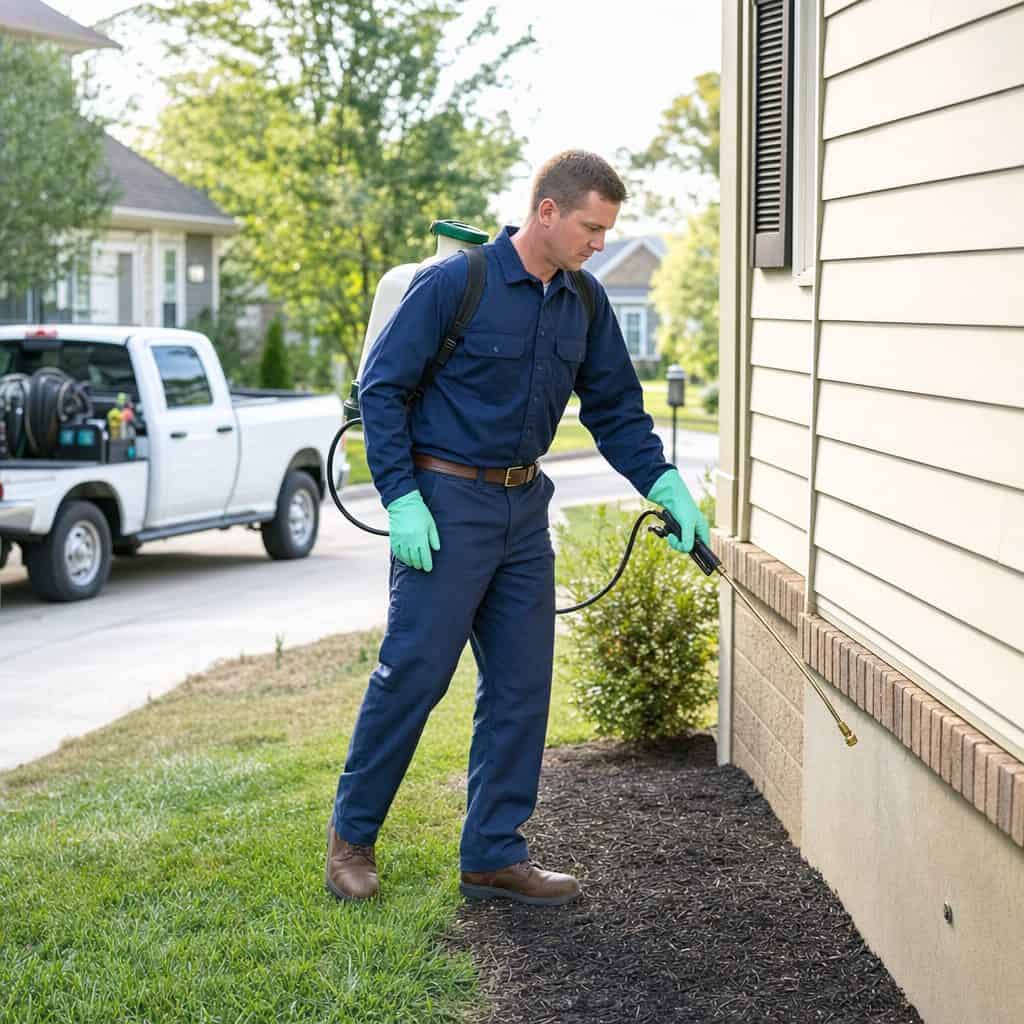
A technician applying pesticide to a client's lawn has product drift onto an adjacent property, killing ornamental plants and triggering a cleanup and replacement claim. Because this is a chemical drift and contamination claim, it falls to pollution liability, not general liability.
Scenario 2: A Missed Termite Infestation Leads to Structural Damage
A WDO inspection clears a property for sale, but termite damage is discovered months later that the inspection should have caught. Because this is a claim about the inspection's professional judgment rather than physical damage the technician caused, it falls to professional liability, not general liability.
Scenario 3: A Technician Is Injured in a Crawlspace
A technician is injured while inspecting a tight crawlspace for termite activity, resulting in medical treatment and time away from work. Workers compensation covers medical bills and a portion of lost wages, and it protects the company from a direct lawsuit by the injured employee.
Scenario 4: A Company Vehicle Is Involved in an Accident Between Stops
A technician driving between service calls causes an accident, damaging another vehicle and requiring medical treatment for its occupant. Commercial auto covers the liability and physical damage, provided the vehicle is properly titled and insured under the business rather than a personal auto policy.
Frequently Asked Questions
What kind of insurance does a pest control business need?
Most pest control businesses need general liability as the foundation, plus pollution liability for chemical spills and overspray, which general liability typically excludes. Professional liability covers claims tied to a missed infestation or ineffective treatment, workers compensation covers technician injuries, and commercial auto covers company vehicles traveling between properties.
How much does pest control insurance cost?
A small pest control operation typically pays around $810 per year for general liability alone. Workers compensation for a technician runs approximately $1,032 per year, and a business owner's policy bundling general liability and property coverage runs approximately $1,687 per year. A company with several technicians carrying general liability, pollution liability, workers compensation, and commercial auto together can expect combined annual premiums of $6,000 to $15,000 or more depending on chemical volume, fleet size, and payroll.
What are the insurance requirements for pest control companies?
Most states require a licensed pest control applicator to carry general liability insurance, and many require proof of coverage as part of the state licensing renewal itself, not just a client contract requirement. Commercial clients and property management companies commonly require a certificate of insurance naming them as an additional insured, and structural pest control or wood-destroying organism inspections often require specific state-mandated coverage minimums tied to that license.
Does standard general liability cover chemical spills or pesticide overspray?
Usually not. Standard general liability policies commonly contain a pollution exclusion that applies to contamination-related claims, including pesticide overspray, chemical drift onto a neighboring property, or a spill during transport. Pollution liability is a separate coverage written specifically to close this gap, and most pest control operations that apply chemicals need it alongside general liability, not instead of it.
What is a pesticide application endorsement and do I need one?
A pesticide application endorsement explicitly confirms that a general liability policy covers bodily injury and property damage arising from applying pesticides, since some standard commercial policies treat chemical application as an exclusion unless it is specifically added back. Confirm with your broker that this endorsement, along with completed operations coverage, is actually included before relying on a general liability quote for pest control work.
What does a pest control insurance application or supplemental questionnaire ask for?
A pest control supplemental application typically asks for the types of services performed (general pest control, termite and WDO work, fumigation, wildlife or vertebrate control), annual chemical volume, number of technicians and vehicles, applicator licensing and certifications, and prior claims history. Underwriters use these answers to price the policy and to confirm which specific endorsements, such as pesticide application or completed operations, the business actually needs.
Can I get cheap pest control insurance, and what affects the price?
The lowest-cost pest control policies are written for solo operators doing general residential pest control with no fumigation or termite work. Price rises with chemical volume, fleet size, technician payroll, and higher-hazard services like fumigation or wood-destroying organism treatment. Shopping the same risk across multiple carriers, rather than accepting a single company's first quote, is generally the most reliable way to lower cost without cutting real coverage.
What makes one pest control insurance policy or agency the best fit for my business?
The best fit includes the pesticide application and completed operations endorsements and pollution liability matched to your actual chemical volume and service mix, not just the cheapest general liability quote. An independent agency that shops multiple A-rated carriers on your behalf, rather than a single company's take-it-or-leave-it quote, is generally better positioned to find that fit.
Does ATG write pest control insurance in my state?
The Allen Thomas Group is licensed in 28 states and writes pest control insurance programs for operations ranging from solo technicians to multi-vehicle companies performing general pest control, termite and WDO work, and fumigation. Call or request a quote to confirm current availability and carrier options for your specific state.
Does workers compensation cover a pest control technician injured on the job?
Yes. Workers compensation covers medical bills and a portion of lost wages for a technician injured while applying chemicals, working in a crawlspace or attic, or driving between properties. It also protects the business from a direct lawsuit the injured employee might otherwise bring.
Get Your Exterminator Insurance Program
The Allen Thomas Group is an independent, family-owned broker licensed in 28 states with access to 15+ A-rated carriers. One call gets you competitive rates from across the market, not a single carrier's take-it-or-leave-it quote. Certificates of insurance issued same day for active policies.