
Texas Commercial Cleaning and Janitorial Business Insurance
The Allen Thomas Group is an independent, family-owned insurance agency that shops 15+ A-rated carriers to build coverage for commercial cleaning and janitorial companies across Texas, not a single-carrier captive agent locked into one company’s rates and terms. We work with Texas cleaning businesses of every size, from a single owner-operator to established janitorial companies running multiple crews across Houston, Dallas, and Austin. Most quotes are ready within 1-3 business days. Click the button below to start your free quote, or call (440) 826-3676 to speak with a licensed agent directly.
Carriers We Represent


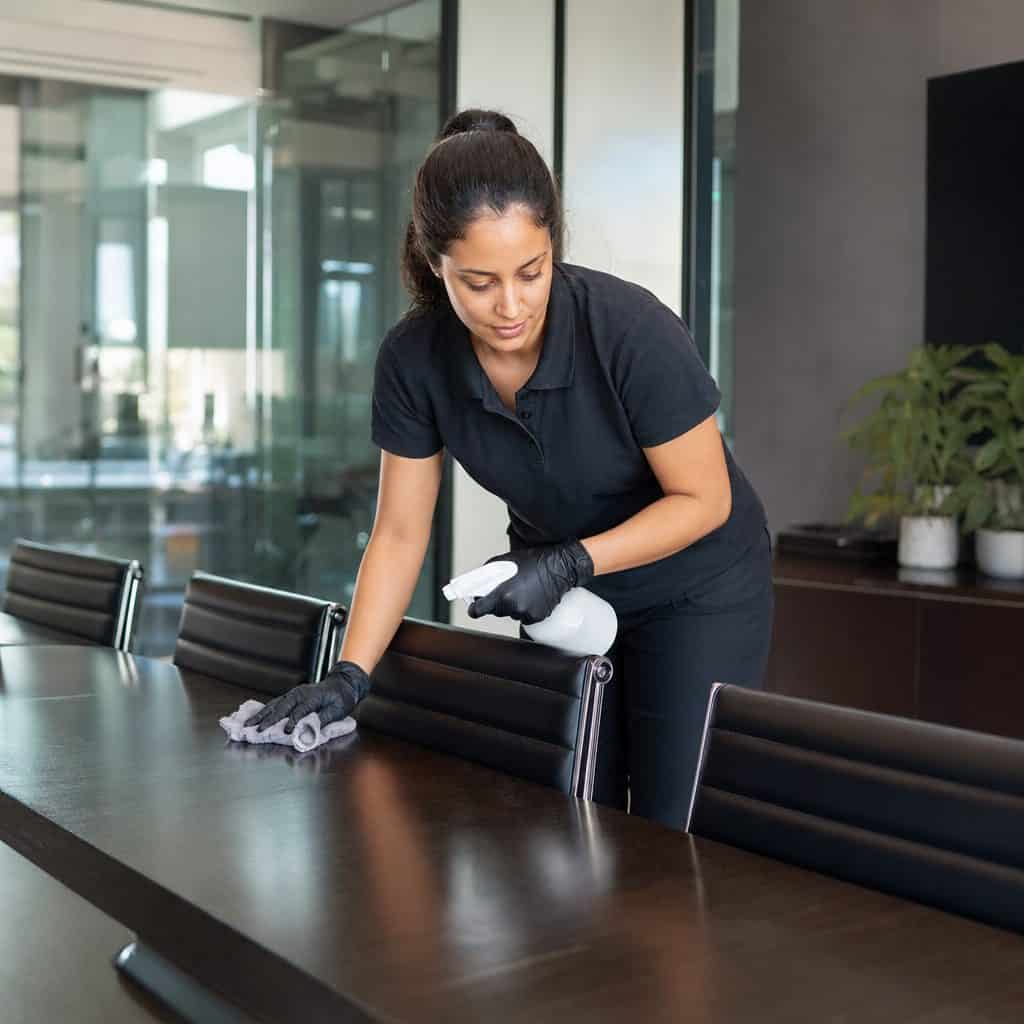
Commercial cleaning insurance in Texas is a specialized bundle of coverage, typically general liability, a janitorial bond, and workers’ compensation, built around the specific risk of sending employees into other people’s offices and businesses across Houston, Dallas, and Austin.
Why Commercial Cleaning Companies in Texas Need Specialized Coverage
Texas’s commercial cleaning industry is concentrated around Harris County (Houston), Dallas County (Dallas), and Travis County (Austin), where high-rise office towers, medical campuses, and sprawling corporate and retail parks create year-round demand for contract janitorial crews. Crews in these metros routinely work inside occupied buildings after hours, often alone or in small teams, moving between tenant suites, server rooms, and shared lobbies. That kind of unsupervised access to other people’s property is exactly where a standard business owner’s policy falls short.
A janitorial crew polishing floors in a Houston office tower can knock over a bucket of floor finish and ruin a client’s carpet or hardwood flooring. A cleaner in Dallas can lose a master fob for a multi-tenant building, triggering a rekeying bill that runs into the thousands of dollars. In Austin, a worker pushing a commercial floor buffer up a loading dock ramp can suffer a back or shoulder injury that turns into a workers’ compensation claim.
Texas-Specific Coverage Considerations for Commercial Cleaning Companies
Texas does not require a special state-level license for commercial cleaning or janitorial businesses. A cleaning company registers its LLC or corporation with the Texas Secretary of State and, if it sells cleaning supplies directly to customers, obtains a Sales and Use Tax permit from the Texas Comptroller of Public Accounts. Some cities ask new businesses to register locally and confirm zoning before operating, but there is no dedicated statewide janitorial license to track.
Texas’s minimum wage is $7.25 an hour, the same as the federal rate, according to the Texas Workforce Commission, which administers the Texas Minimum Wage Act. Texas has not raised its wage floor above the federal rate, so payroll for cleaning crews tends to be driven more by local labor market competition than by a state-mandated increase. Since workers’ compensation premium is calculated largely from total payroll and classification code, a cleaning company’s actual wage rates, not just the state minimum, drive most of its coverage cost.
- Texas workers’ compensation runs through the private insurance market rather than a state fund, so cleaning companies shop coverage across competing carriers based on classification code and experience modifier.
- Texas is also one of the few states where workers’ compensation coverage is elective. Companies that go without it become nonsubscribers and must report that status to the Texas Department of Insurance’s Division of Workers’ Compensation.
- No state-level license is required for commercial cleaning, only standard Secretary of State entity registration and, where applicable, a Sales and Use Tax permit from the Texas Comptroller.
- Many Texas cleaning companies mix commercial contracts with residential or short-term rental turnover work, which can call for different liability limits and endorsements depending on the property type.
- Along the Gulf Coast, commercial cleaning companies see recurring demand for storm and water-damage cleanup after hurricane season, often on short notice in flooded or debris-filled buildings.
- Subcontractor use is common on large multi-building contracts, so verifying certificates of insurance on every subcontractor protects against coverage gaps.
- Equipment coverage protects buffers, extractors, and vehicles in transit between job sites, and lost-key and rekeying exposure is a real, recurring cost for crews servicing high-rise towers in Houston, Dallas, and Austin.
Coverage Types for Commercial Cleaning & Janitorial Companies
Here’s what each policy actually covers, in plain terms, along with a link to the full coverage page where one exists:
General Liability Insurance
Covers third-party bodily injury and property damage your business causes while on a client’s premises.
Such as a client slipping on a wet floor after mopping, or a spilled chemical that damages a carpet. This is the coverage most commercial clients in Texas require before signing a cleaning contract.
Janitorial Bond
A surety bond, not insurance, that reimburses a client if an employee steals money or property while cleaning their home or business.
It covers theft specifically, not accidental damage, and helps establish trust with Texas clients who won’t hire an unbonded cleaning company.
Workers’ Compensation Insurance
Required in Texas once a cleaning company has any employees, part-time or full-time.
Coverage is shopped across competing private carriers based on your classification code, payroll, and claims history.
Commercial Auto Insurance
Required for vehicles owned by the business, covering property damage and medical bills from an accident.
Used to transport crews, equipment, or industrial chemicals between job sites across Texas.
Inland Marine (Tools & Equipment) Insurance
Covers cleaning equipment, such as floor buffers, carpet extraction machines, and ladders, while it’s in transit or on-site.
Commercial auto insurance covers the vehicle itself, not the equipment riding inside it, which is exactly the gap this coverage closes.
Business Owner’s Policy (BOP)
Bundles general liability with commercial property insurance into a single, typically lower-cost policy.
If you lease or own an office or storage space for your supplies, small, low-risk cleaning businesses are usually eligible.
Commercial Umbrella Insurance
Adds additional liability limits on top of general liability, commercial auto, and employer’s liability coverage.
Cleaning companies bidding on larger Texas commercial contracts often need this to meet a client’s required liability limit.
Lost Key Coverage
Reimburses a commercial property for the cost of rekeying locks and reissuing keycard systems if your employee loses master keys.
Larger commercial and multi-tenant properties in Houston, Dallas, and Austin increasingly ask about this coverage specifically before signing a contract.
Why Bonding and Insurance Matter for Texas Cleaning Companies
Commercial cleaning crews are given access to offices, retail spaces, and sometimes homes across Texas, often unsupervised and after hours. Property managers, business owners, and hosts of short-term rentals routinely require proof of both insurance and bonding before signing a contract or handing over keys and access codes. Being able to produce a certificate of insurance and proof of a janitorial bond on request is now a standard part of winning and keeping commercial cleaning contracts in Texas, not an optional extra.
Related Coverage
Texas Commercial Cleaning and Janitorial Business Insurance FAQs
Does Texas require a special license for commercial cleaning businesses?
No. Texas does not have a state-level license specific to janitorial or commercial cleaning companies. Businesses register their LLC or corporation with the Texas Secretary of State and obtain a Sales and Use Tax permit from the Texas Comptroller if they sell supplies directly, and some cities add their own local registration.
How does workers’ compensation work for a cleaning company in Texas?
Texas is one of the few states where workers’ compensation coverage is elective rather than mandatory, and it runs entirely through the private insurance market rather than a state fund. Companies that carry coverage shop it across competing private carriers, with cost driven mainly by payroll, classification code, and experience modifier, while companies that opt out become nonsubscribers and must report that status to the Texas Department of Insurance’s Division of Workers’ Compensation.
Which Texas cities have the most demand for commercial cleaning contracts?
Houston (Harris County), Dallas (Dallas County), and Austin (Travis County) have the state’s largest concentrations of office towers, medical campuses, and corporate parks, which sustains steady demand for contract janitorial and commercial cleaning services in those metro areas.
What insurance does a commercial janitorial or cleaning company actually need?
Most commercial cleaning companies need four core policies: general liability insurance, workers’ compensation if you have employees, commercial auto insurance if crews drive between job sites, and a janitorial bond to reimburse clients for employee theft. Companies that lease office or storage space, carry expensive equipment, or bid on larger commercial contracts often add a business owner’s policy, inland marine coverage, and commercial umbrella insurance on top of those four.
What is a janitorial bond, and is it the same thing as insurance?
A janitorial bond, also called a fidelity bond or business service bond, is a type of surety bond, not insurance. It reimburses a client if one of your employees steals money or property while cleaning their home or business. Unlike an insurance claim, a surety company that pays out on a bond claim expects your business to reimburse it afterward, so it protects your client’s trust in you more than it protects your own bottom line.
Does my cleaning company’s insurance cover damage to a client’s property, or only theft?
General liability insurance covers accidental property damage, like a spilled cleaning chemical that ruins a client’s carpet. A janitorial bond covers something different: theft or dishonest acts by an employee. Most commercial cleaning companies need both, since they protect against two different kinds of loss.
Will my commercial auto insurance cover cleaning equipment I carry between job sites?
Not automatically. A standard commercial auto policy covers the vehicle itself and injuries or damage from an accident, not the buffers, vacuums, or extraction machines you’re transporting. Inland marine insurance is the coverage built specifically to protect cleaning equipment while it’s in transit or on a job site away from your main location.
How do I get in touch with a licensed agent about coverage for my cleaning company?
Call (440) 826-3676 to speak directly with a licensed agent, or request a free quote online and a licensed agent will follow up to go over the specific coverage your Texas cleaning business needs.
Get Coverage Built for Your Texas Cleaning Business
Talk to a licensed agent who will shop 15+ A-rated carriers to find coverage that actually fits your crews, equipment, and contracts.